
PART I
The newspaper L’Avenir du Tonkin (The Future of Tonkin, February 25, 1932) wrote about the achievements of Indochina Fine Arts College after the first five years of operation, at the 1931 Paris International Colonial Exhibition: “… The participants of the exhibition achieved remarkable results. The proceeds from the sale of paintings amounted to about 60,000 francs, while one student alone, Mr. Nguyễn Phan Chánh, earned 20,000 francs from silk paintings. It should be noted that the current period is particularly difficult and in difficult times like the present, selling 60,000 francs worth of paintings is quite a result… The British were interested in the results achieved by Indochina Fine Arts College, and decided to organize an exhibition of this school in London. The exhibition is now open, if there are no obstacles… In Paris, everyone talks about Indochina Fine Arts College, and art connoisseurs are very enthusiastic in discussing the individual talents of Nguyễn Phan Chánh, Nam Sơn, Lê Phổ. That is something to remember.”
THE BEGINNING
The European oil painting technique, of which Van Eyck is considered the inventor, is essentially the successor to a transitional technique that had been known since the 11th century, but was still not widely used until the 14th century.
Van Eyck’s invention, therefore, to put it more deeply, is a “perfection”, leading to an ultimate historical definition of the so-called “oil painting” – as a genre, along with a whole system of concepts associated with it.
According to Western art historians, the time of Van Eyck’s invention was around 1410.
In our country, if the time of birth of lacquer painting can be determined precisely in 1932 (the year of the invention of Trần Quang Trân) – can the time of birth of silk painting be determined precisely?
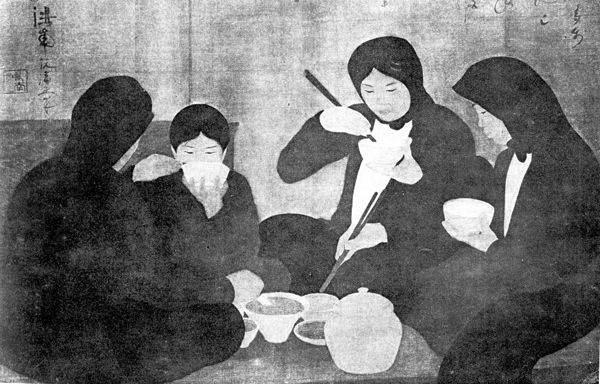
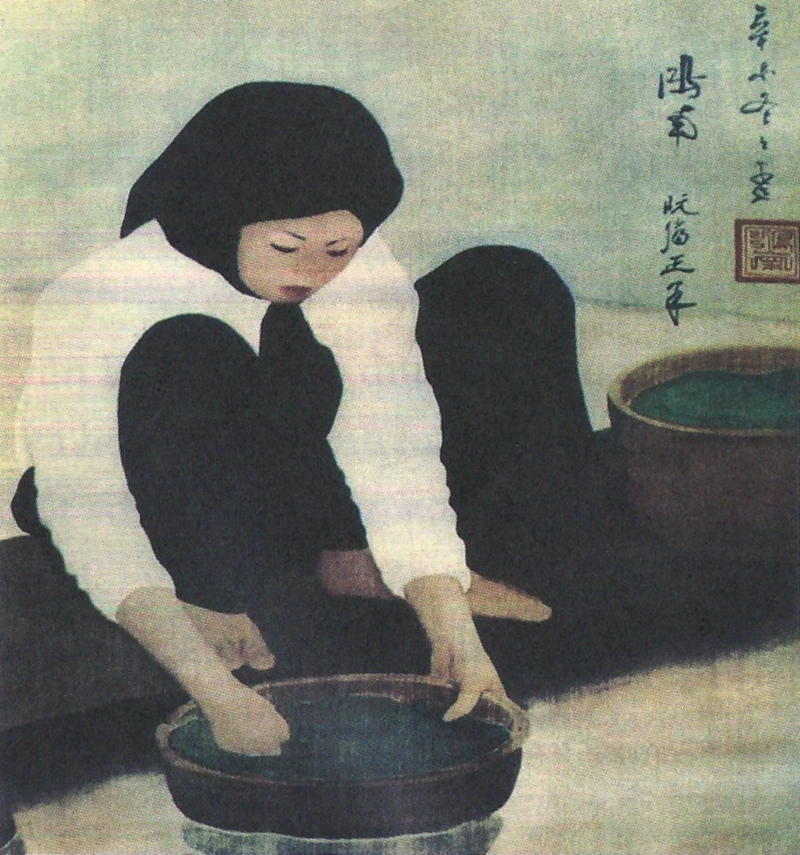
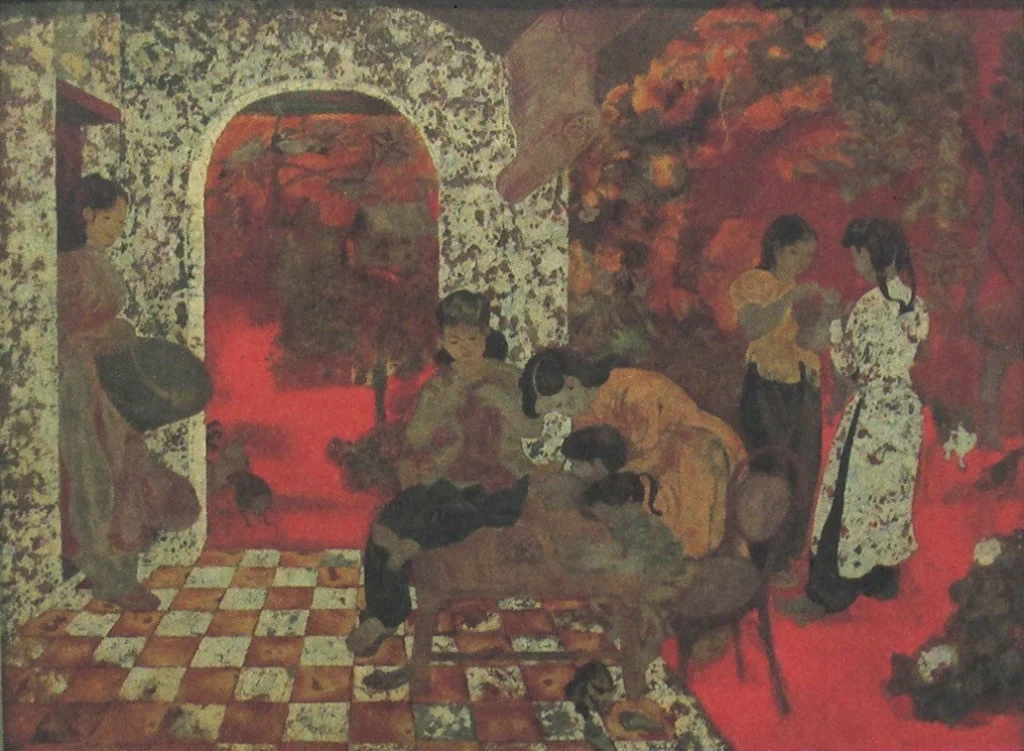
NGUYỄN PHAN CHÁNH. The meal. 1929. Silk. Exhibition in Paris 1931
As everyone knows, the Chinese were the first people on earth to paint on silk, even before they discovered paper. Chinese silk painting reached its peak during the Tang and Song dynasties, which is about a thousand years ago.
As a country located in the East Asian cultural region, in terms of painting, we have had a long period of time when there was almost nothing to compare with the Chinese, except for a few lines of “folk painting” (if this concept is accepted), especially Đông Hồ paintings, which can only be counted from the 17th century. This “delay” has not yet been satisfactorily explained.
The reason for its birth as well as the uniqueness of Vietnamese silk paintings in the early period, seems to have been “indirectly” clarified by French scholar Claude Mahoutot with a dual explanation of foreign influences: “The interesting and important thing to note is that it was thanks to the French and after having contact with European painting that the Vietnamese people learned about and understood the great painting of the Chinese” (Indochine, No. 171, December 9, 1943).
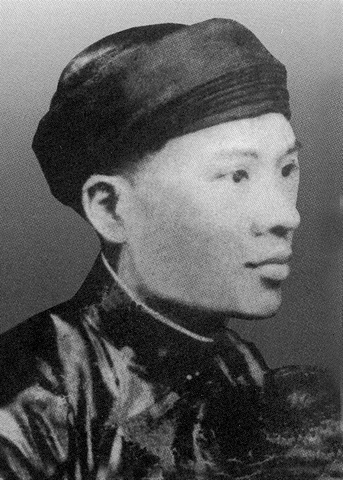
Nguyễn Phan Chánh, 1924
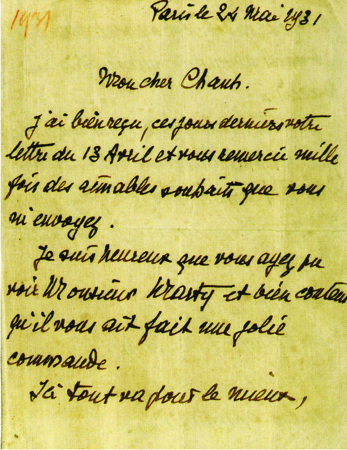
The first page of Victor Tardieu’s letter to Nguyễn Phan Chánh about the success of
Indochina Fine Arts College at the 1931 Paris Exhibition (Paris, 24/5/1931)
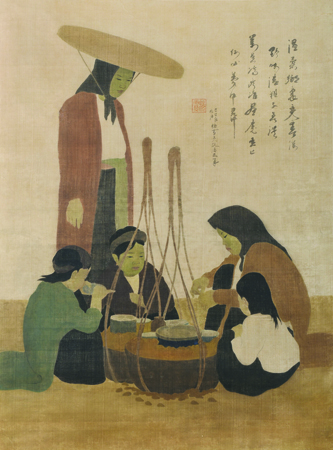
NGUYỄN PHAN CHÁNH. The snail seller. 1929. Silk. Private collection
(Sold for $600,000 at Christie’s Hong Kong on May 27, 2018)
According to Nguyễn Tư Nghiêm, one of the greatest achievements worth acknowledging of Indochina Fine Arts College, especially of Mr. Victor Tardieu, the founder of the college in 1925, was to direct Nguyễn Phan Chánh to the art of silk painting.
In the essay “The beginning of modern Vietnamese painting” (published in the magazine “Xuân Thu Nhã Tập” in 1942), Tô Ngọc Vân recalled:
“… The contact of the Fine Arts College with the public began with the first exhibition around 1928-1929 (exactly in November 1929- H.T.H), right at the fine arts college. There was the painting of ‘a young girl with her hair down’ with a sad face by Lê Phổ, the painting of ‘a young girl sitting on a bed’ with wet eyes as if about to cry by Mai Trung Thứ. There are gentle paintings of an old man by Lê Thị Lựu, heavy and dark brown paintings of countryside scenes by Nguyễn Phan Chánh (all are oil paintings – H.T.H).” Silk paintings have not been born yet (underlined by H.T.H). In 1931, at the Paris exhibition, some of Nguyễn Phan Chánh’s “first” silk paintings achieved great success. And history also considers them as one of the earliest and most important successes of 20th century Vietnamese fine arts. Nguyễn Phan Chánh was therefore obviously recognized as the master painter who opened the door to Vietnamese silk painting. The date of his famous paintings, for unknown reasons, was assigned to two years: 1930-1931, which, invisibly, also became the official date for the beginning of silk painting.
This also “seems” to be very consistent with Nguyễn Phan Chánh’s art biography, because it states: He only started “practicing painting on Yunnan silk” from 1928.
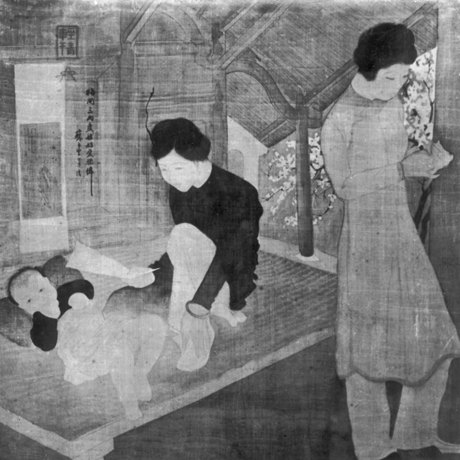
TÔ NGỌC VÂN. The letter. Circa 1930-1931. Silk. Việt Nam Fine Arts Museum
However, recently, some new evidence has been found that will give us a more complete, comprehensive and realistic view of the beginning of silk painting.
Firstly, according to the documents of Mr. Ngô Kim Khôi, an independent researcher, the grandson of artist Nguyễn Nam Sơn, Mr. Nam Sơn made a silk painting titled “Return from market” in 1927, but it has not been confirmed whether that was his earliest silk painting or not?
So, if Mr. Nam Sơn is not (or has not yet) recognized as the initiator of Vietnamese silk painting art (like Nguyễn Phan Chánh) – then at least in our country, he can still be the first person who laid the foundation for the history of the formation and development of silk painting. As early as 1930, he published a book in French entitled “La peinture chinoise” (Chinese painting), with the main idea: Nature – the “eternal and endless” source for painters. The book also shows the initiative, a very clear awareness of Vietnamese painters towards their Asian roots, even when they were studying and receiving art lessons in the French educational environment.
Second, at least two pieces of evidence have been found to prove that: Nguyễn Phan Chánh had a number of silk paintings that were proper artworks (if not really master works) as early as 1929, that is, only one year after he started “practicing painting on silk”. Of the two silk paintings, the most notable is “Le Repas / Meal”, because in fact, it is certainly one of the silk paintings by Nguyễn Phan Chánh that was displayed and purchased at the exhibition at Paris exhibition in 1931 (currently only visible through a print in the French photo newspaper “L’Illustration”, No. 4608, June 27, 1931, with a very clear date: 1929). The other is “The snail seller” (sold for 600,000 USD at Christie’s Hong Kong on May 27, 2018).
From here, we have the basis to replace an estimated way of saying the beginning of Vietnamese silk paintings as “1930-1931”, with a fixed way of saying: 1929.
That also means that this year – 2019 – is the 90th anniversary of the birth and development of Vietnamese silk paintings.
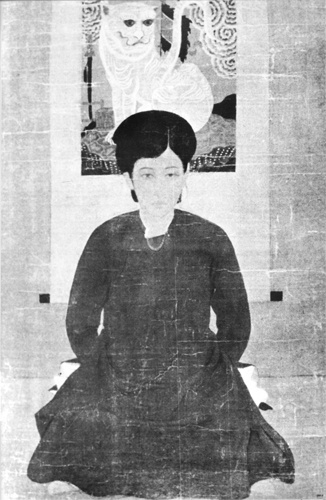
LÊ PHỔ. Sitting woman. 1934. Silk. Foreign private collection
NAME
In terms of “materiality”, perhaps the most common way to name a type of painting is to answer the question: “sur quoi et avec quoi?” (on what and with what?). For example: Oil on canvas (French: Huile sur toile).
In French or English, to refer to oil paintings, people can also just say: Huile, oil (in general), or: Toile, canvas (in the case of painting on canvas). For common types of paintings drawn on paper, in French or English, people often just say: Aquarelle or watercolor, gouache, pastel, etc.
As for silk paintings (Chinese or Vietnamese), the French often call: Peinture sur soie (meaning: painting on silk), or just say: Soie.
The recent complexity and confusion about the term “silk painting”, which is often inaccurate, certainly arose from the need to translate the word “silk painting” into foreign languages.
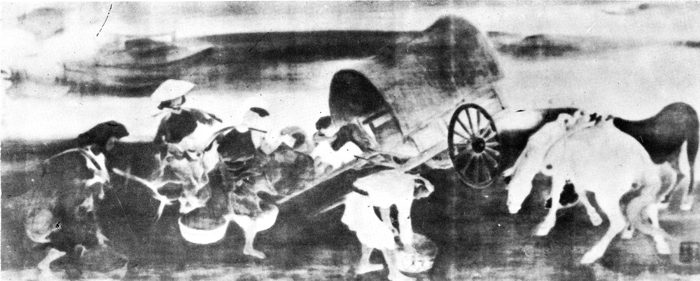
TRẦN VĂN CẨN. Carrying sand at Hồng riverbank. 1936. Silk. Lost outside the country
Which are: watercolor on silk (aquarelle sur soie); which are: gouache on silk (gouache sur soie); which are: ink on silk (encre sur soie), sometimes even to the point of being stuck: colors on silk (couleurs sur soie)… – as if people had a firm grasp, knew everything the painter used. And if we assume that – then with natural colors, such as ripe brown-yellow dyed by the painter, sprayed with tea water, syzygium nervosum water, can people count or not? Perhaps we should just call silk paintings… “silk paintings” or “silk” (which is translated into French as: peinture sur soie, or more concisely: soie) as its original name. In special cases, it can be written, for example: silk painting (with acrylic) or- silk (with acrylic). It is important to note that silk is not simply a support, but silk is also a surface, an important means of display and expression of silk painting. To indicate a silk painting, we may not need to answer the question “avec quoi” (painted with what), but to the question “sur quoi” (painted on what), the answer is crucial.
TECHNIQUES
Silk painting originally belonged to water painting (peinture à l’eau), painted with substances and colors mixed with water. Painters can purely use Chinese ink, natural herbal colors, watercolors or gouache to paint silk, or flexibly combine them with other colorants such as mollusks, pastels, colored pencils, etc. Some people also use tempera, oil (Lê Phổ for example), and recently acrylic (Bùi Tiến Tuấn for example) to paint silk.
In general, colorants with strong “covering” and “holding” properties are less suitable for silk, they can bring about a fast, solid effect, but lack clarity, depth and smoothness. According to Trần Văn Cẩn’s experience, blank silk areas that are not painted still need to be painted a little or more, even if it has to be painted with white, because completely colorless silk will cause mold.
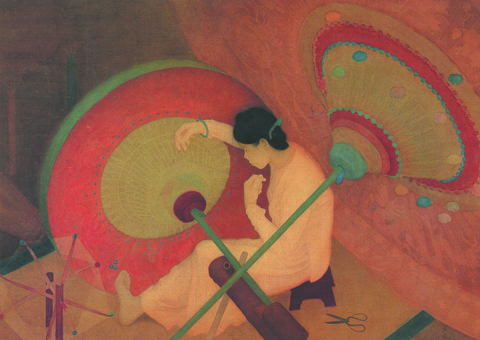
LƯU VĂN SÌN. Making umbrellas. 1935. Silk. Foreign private collection
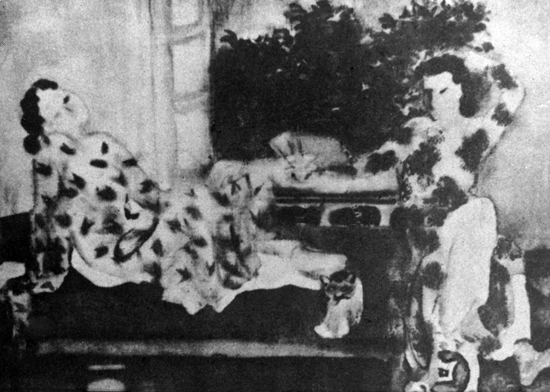
NGUYỄN TƯỜNG LÂN. Two girls by the window. 1943. Silk. Photo archive
In principle, any silk can be painted, but not all silk is suitable for all artists. In the mid-1930s, some artists, especially Trần Văn Cẩn, loved to paint on oak silk, a traditional type of silk with rough, “veined” fibers, but it was limited in size (just over 40 cm a little), and it could not be white (and to be painted, it had to be bleached with green papaya peel water). Therefore, most of Trần Văn Cẩn’s old silk paintings have a narrow rectangular frame, arranged vertically or horizontally, or else they are small in size. In the 1980s and 1990s, the type of thin, rough, slightly sloppy silk with a grayish tint, produced in Đà Nẵng, was also favored by artists. It gives silk paintings very strange nuances, to the point that it has almost become an important element in creating the silk painting style of some artists.
Certainly, silk painting requires the silk to be stretched into a flat piece to be painted. According to the tradition from Nguyễn Phan Chánh, stretching silk on a wooden frame with glue or nails is the most popular method. This method is very convenient for the “wash” painting style, but in the painting process, it somewhat limits the control of the actual, direct effect, and is prone to sagging and holes… Vietnamese artists living in France such as Mai Thứ or Lê Thị Lựu painted on a silk background that has been mounted (almost like drawing on paper), but ready-mounted silk is only suitable for the “dry” painting style, even only drawing with colored chalk.
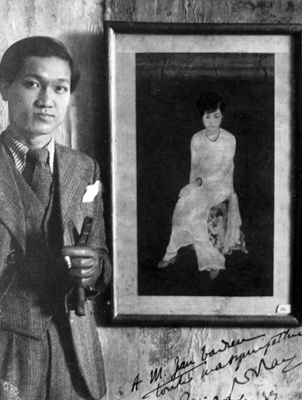
Nguyễn Tường Lân next to his work “Flower appearance”,
photo taken in 1939
There is another way of stretching silk, more recently: glue the silk onto a white laminated board, and paint on it, washed or dry, especially for large-format paintings. Once finished, peel it off and mount it to paper as easily as usual.
The most challenging step in silk painting is the mounting. In the past, there were specialized craftsmen in charge of this job; nowadays, there are still some, but they are few and not as highly regarded.
Because it’s difficult (especially requiring knowledge of the powder preparation and paste cooking techniques), some artists don’t mount or prepare their paintings, simply cutting the painted silk, attaching it to a frame with glass to cover. Mounting silk is most problematic at night, especially during the subsidy period; if the power goes out while you’re working on a silk painting, it’s all gone!
In reality, silk paintings are just as durable as other types of paintings, if the artist makes it correctly, mounts and prepares it properly, and it is preserved correctly. Certainly, climate and weather conditions also have a significant impact on the durability of silk paintings, but we have this same problem for any type of painting.
Silk paintings by Hàn Cán from the 8th century (Cernuschi Museum, Paris), or some silk paintings from the 1930s by Nguyễn Phan Chánh, Lê Phổ, Tô Ngọc Vân, Trần Văn Cẩn, Lưu Văn Sìn and Lương Xuân Nhị (in collections in France and the US) are currently in good condition. In our country, if silk paintings are damaged, we shouldn’t blame it entirely on the lack of durability of silk, because even with lacquer paintings (painted with traditional lacquer used for decoration and preservation), we have not been able to preserve them as well as we’d hoped.
Written by Hà Thái Hà, posted on the website of Fine Arts Magazine
http://tapchimythuat.vn/my-thuat-hien-dai-viet-nam/90-nam-tranh-lua-viet-nam-may-chu-giai-ve-lich-su/