
Vietnamese painting, it can be said, is one of the most versatile painting in the world, using almost all materials from East to West, from ancient to modern, from foreign to indigenous, including both “inherited” and “self-created” materials. And, it seems that in every material, Vietnamese painting has outstanding artists, even some artists only need one or two works in the same material to have a place in the history of painting. The number of “all-round” artists – proficient in types of materials, or proficient in most materials – is not necessarily rare. Artists such as Nguyễn Gia Trí, Trần Văn Cẩn, Nguyễn Sáng, Nguyễn Tư Nghiêm are all-round artists like that, in almost every material they have excellent works. Obviously, we Vietnamese are not the ones who “invented” silk paintings. This is only about lacquer paintings. But in the 20th century, the era of modern art, we have clearly “restructured” silk paintings into a previously unknown form of painting, not only purely in terms of form, but mainly with a new, unique worldview and outlook on life of Vietnamese people, on the process of cultural and artistic acculturation with the West through the bridge of French culture and art.
From a “pure” point of uniformity in space and time that is inevitable, but actually accidental, thanks to the clear vision of a few individuals, our inherent sensitive and astute “assimilation” ability has transformed silk paintings – an art form that is considered ancient, “inert and conservative”, into an art full of vitality and potential that has been affirmed by the continuity of a process spanning two centuries.
Nguyễn Phan Chánh and the first period
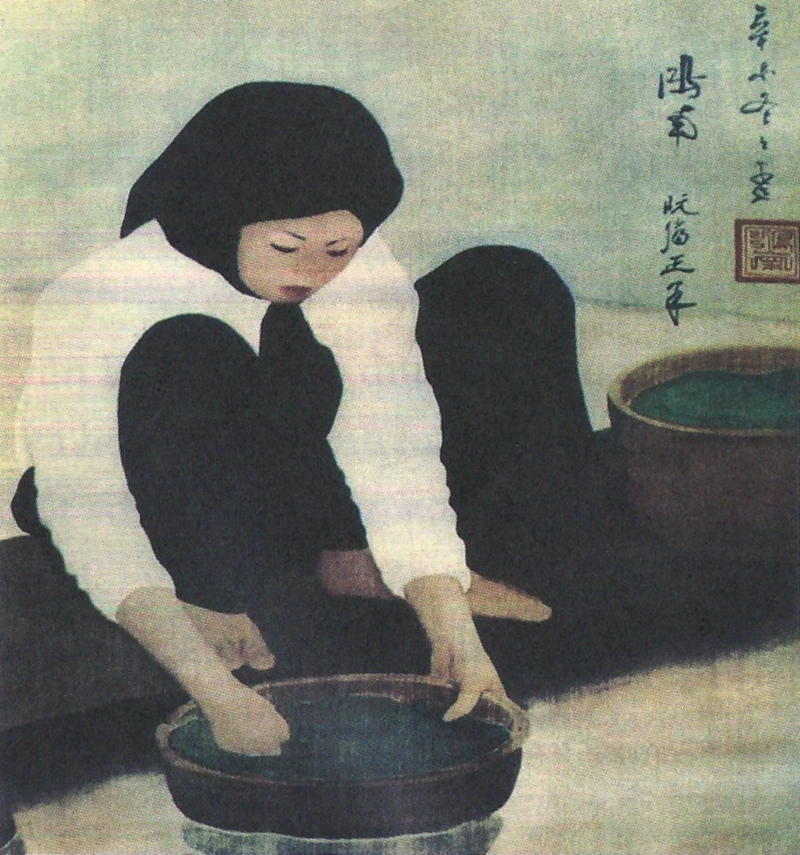
The embodiment of silk paintings is actually just a thin, very diluted film of color (or ink). Therefore, silk is very suitable for expressing both the view from the outside in and the view from the inside out, or in other words, the harmony between mind and matter. A painting on paper transferred to silk has a completely different dignity, often synonymous with transforming a document into a work. We often say that Nguyễn Phan Chánh consulted Tang and Song silk paintings to find a way to paint Vietnamese silk paintings, but more precisely, his paintings tend to follow the taste of Song studies, the essence is concentrated in “tranquility” (Zen). The form-emptiness of Zen combined with the non-existence of Laozi made him always awared of the meaning of the blank areas. Zen and Taoism penetrated each other to create the taste. The impression received is often subjective, rich in wisdom, simple to the point of serenity.
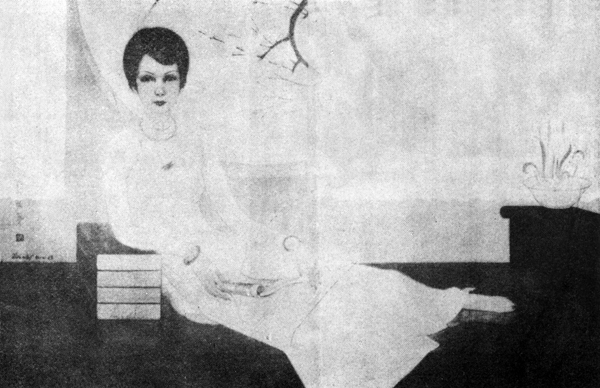
LÊ VĂN ĐỆ. Portrait of Ms Ch. 1943. Silk. Photo archive.
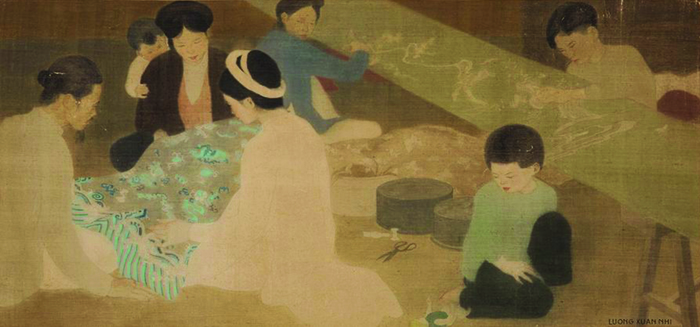
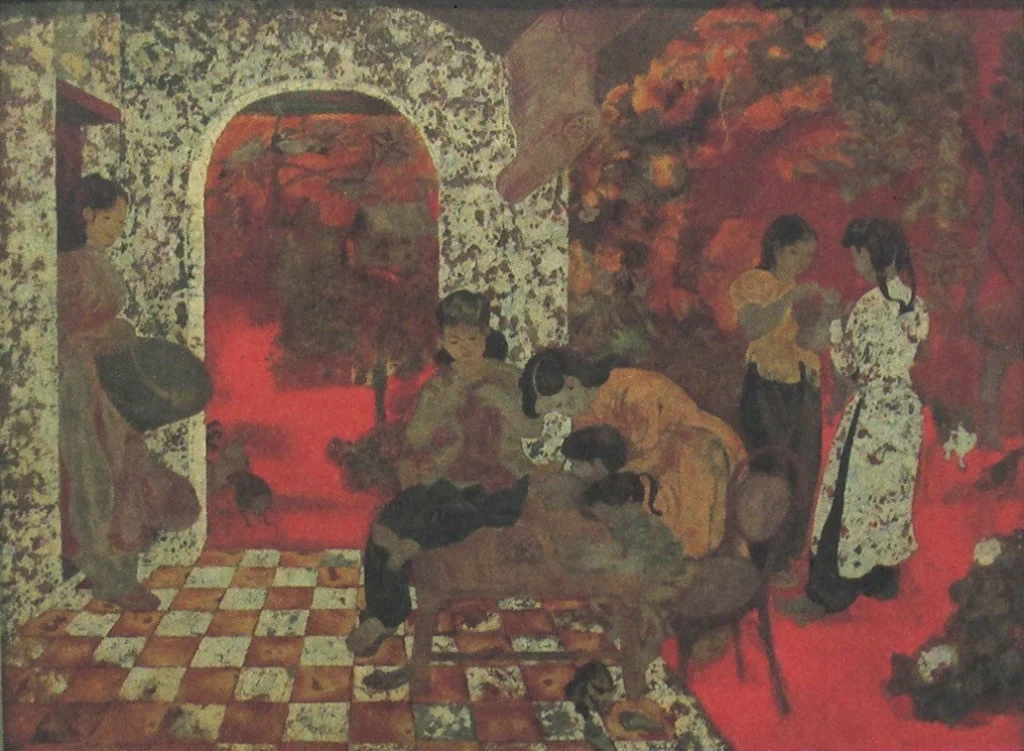
LƯƠNG XUÂN NHỊ. Embroidery workshop. Circa 1936-1937. Silk. Private collection
Regarding the silk paintings by Nguyễn Phan Chánh exhibited at the 1931 Paris Exhibition, Jean Gallotti wrote:
“… In the front row is Mr. Nguyễn Phan Chánh, the artist of silk paintings who is truly a master. The paintings ‘The street singers’, ‘The meal’, ‘The sewing girls’, present real scenes, drawn without lines, in large, almost monochromatic blocks, with grey, black, reddish brown, greyish brown, creating a peaceful look, making people feel very deep. The harmony of the composition, sometimes the grace of the faces, and always the poetic taste imbued with the life of Far East, a diffusion of a soul different from ours, which we feel very close to due to a sympathy in the love of beauty, we are enveloped by a mystery.” (L’Illustration, No. 4608, June 27, 1931, Paris).
Clearly, Nguyễn Phan Chánh proved that silk had the potential to become a unique voice of Vietnamese painting, and from the late 1920s to the mid-1930s, his art reached its highest peak. Such a beginning, with such a beginner – was truly too glorious.
The 1930s were certainly the first period, and can also be considered the golden age of silk painting. During this period, with silk, there was almost no painter who did not experiment.
Since he was studying at Indochina Fine Arts College, Nguyễn Gia Trí was passionate about the art of lacquer painting, but in the end he graduated with a silk work (1936). After graduating, he continued to delve into lacquer, and after only a few years, became the most famous lacquer master. Then in 1945, right after August Revolution, at the Cultural Exhibition organized by National Salvation Cultural Association at Khai Trí Tiến Đức House (Hà Nội), instead of a lacquer painting, people were surprised to see “a silk painting with several nude girls, the colors appearing and disappearing like a strange tale” by Gia Trí. This partly shows the irresistible allure of silk material. It can satisfy a artist’s need for expression depending on very different scenes and situations. Trần Văn Cẩn seemed to be the opposite of Nguyễn Gia Trí. He graduated from Indochina Fine Arts College with a lacquer work, but then focused on silk painting, a period of “loneliness” and “quietness” as he himself said.
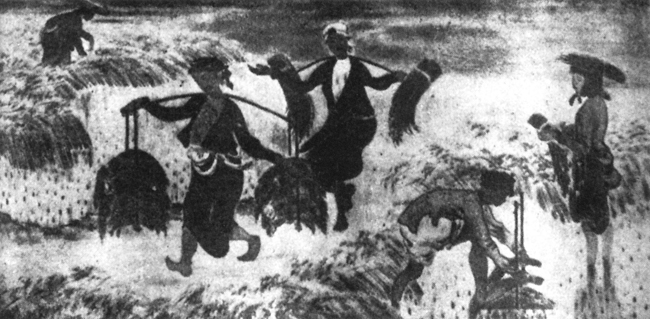
NGUYỄN TIẾN CHUNG. Harvest. 1943. Silk. Photo archive
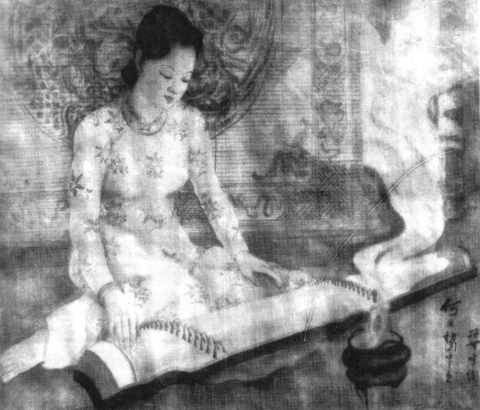
TÔN THẤT ĐÀO. Young woman playing music. Silk. Photo archive
Trần Văn Cẩn (as well as Nguyễn Gia Trí) is one of the first all-round painters in our country. He always fluctuated between materials, and in each material he had pinnacle works that can represent each period of Vietnamese fine arts. When talking about Trần Văn Cẩn’s paintings, it is impossible not to mention the art of silk painting, if not to say that silk is his best and most proper painting. As one of the few first painters to bring silk paintings into real life, closely linked to the lives of working people, with a gentle, humane perspective, full of sympathy, the poetry in Trần Văn Cẩn’s silk paintings seems to touch hearts. With silk, he had a bold and surprising composition style, sometimes close to the “pillar” form (long vertical – kakemono), sometimes close to the “volume” form (long horizontal – makimono), the drawings are very “rogue”, large and wide, light and dark gracefully like Tang poetry (see illustration Part I, Fine Arts Magazine issue May-June 2019). From the first silk paintings (around 1933-1934, such as ‘My mother’), he painted silk quite regularly until 1954-1955 (‘Reading for father’, ‘Plowshare foundry in the resistance war’, about 20 years, then almost stopped.
The silk painting ‘Down to the fields’ displayed at the first National Fine Arts Exhibition held at Hà Nội Opera House, autumn 1946, can be considered the work that opened a new period for Trần Văn Cẩn, the “joyful-excited” period of a revolutionary-resistance painter. Sharing the same realistic approach, Lương Xuân Nhị differed from Trần Văn Cẩn in the eyes of an urban intellectual from Hà Nội, talented, elegant, and at one time the most famous for his refined and smooth art. His silk paintings of landscapes, daily life, or young women are imbued with natural light and color, through the spacious expression of large areas, with light shadows on simplified shapes, with a warm, interesting, and fragrant beauty. All of his silk paintings created in 1936-1937 were selected to participate in the exhibition in Paris held at the same time. (Recently, in 2019, at an international auction by Aguttes in Paris, a silk painting by Lương Xuân Nhị titled “Embroidery workshop” reached a price of over 500,000 euros. In terms of aesthetics, it can be compared to the famous silk painting “Court ladies preparing newly woven silk” by Zhang Xuan, from the Tang Dynasty, China – see illustration).
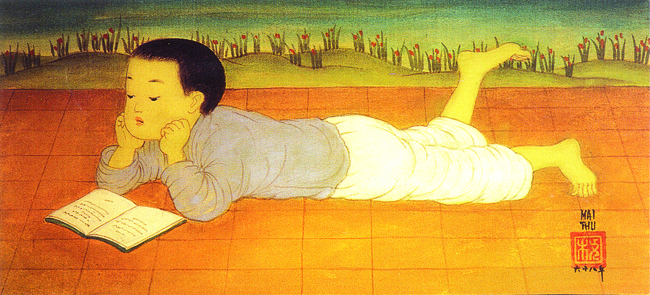
MAI THỨ. A child reading. Silk. Foreign private collection
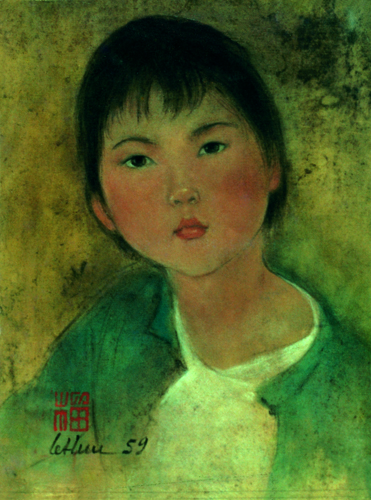
LÊ THỊ LỰU. Portrait of a child. 1959. Silk. Hồ Chí Minh City Fine Arts Museum
… People still remember Lưu Văn Sìn through the silk painting “Making umbrellas” (1935, see illustration Part I). He put colors into the image and tiny decorative motifs with precision and sophistication like the printing technique in Japanese woodblock prints in 17th century. Lê Yên had the silk painting “The toy seller”, Nguyễn Thị Nhung has “Young woman and chrysanthemum”…
Tô Ngọc Vân also spent many years painting silk, scattered from 1930 to 1940. To paint modern urban young women, he put into silk a very strange color of brown and purple, blending the ancient spirit with the taste of the new era (typically, the silk painting of two young women reached a price of nearly 1,200,000 USD at Christie’s Hong Kong in April 2019).
Nguyễn Tường Lân sometimes brought silk into the ancient, misty atmosphere of Chinese silk paintings, sometimes he broke the mold and opened up a diagrammatic drawing style with large, dark brush strokes contrasting strongly on a light background, giving silk a rare comfort and freedom (see illustration Part I). At Salon Unique 1943, Nguyễn Tiến Chung stood out with the silk painting ‘Harvest’, a very witty drawing, as if bringing both dance and music into the painting. He seemed to be born to paint silk. Rarely seen in any painter like him is the softness, flexibility, melodious rhythm, the colors are sometimes rustic, sometimes gentle, sometimes splendid and passionate with an Asian feel, sometimes drawing stylized figures in a folk style, sometimes elevating them to a scholarly style, the silk surface before and after painting still retains the smooth, silky layer, one must look closely to fully appreciate the sophisticated, delicate beauty.
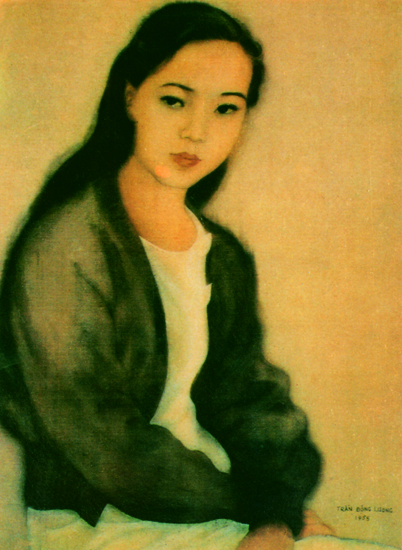
TRẦN ĐÔNG LƯƠNG. Youth. 1958. Silk. National Museum of Oriental Art,
Russian Federation
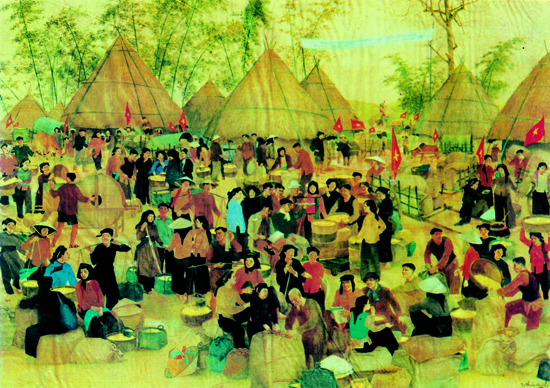
TẠ THÚC BÌNH. Contribute rice to granary. 1960. Silk. Việt Nam Fine Arts Museum
In Nguyễn Tiến Chung painting in general, and silk painting in particular, there are three main elements: the “young brown” quality of the fields and rural life in the North, the “brown” quality of Buddhism and the “silk” quality of urban women. He absorbed elements of Western and Eastern aesthetics to become a talented modern painter of Southeast Asia.
Trần Văn Thọ painted young women in ancient costumes with the rhythm of Kinh Bắc folk songs.
In Huế, painters such as Tôn Thất Đào and Phạm Đăng Trí also created a unique direction for silk paintings. Although they all painted about Huế, the dreaminess in the paintings of Huế painters are very different from those of Northern painters. Huế painters, whether looking from afar or looking up close, the scenery is still trembling, the compassion and nostalgia come from the depths of their consciousness.
There are at least five or six Southern painters who are good at silk. First, Lê Văn Đệ, who basically followed the neoclassical trend and found a unique national style in silk painting. His silk paintings have both the conciseness and freshness of 17th-18th century Japanese woodcuts and the simplicity of ancient European Catholic art, but the spirit is imbued with Việt Nam. He is famous for his sophisticated techniques and good description of the subject, especially when painting elegant and graceful young women.
Lưu Đình Khải, the second painter of Cochinchina to mention, was a painter who was good at silk painting. His silk paintings when he was a student were selected by Victor Tardieu himself as a gift to express gratitude to the President of the National Assembly Phạm Huy Lục, who stood up to protect the existence of Indochina Fine Arts College against the risk of being closed by the colonial government in the early 1930s. Currently, in Paris, those paintings are still preserved by Mr. Lục’s descendants.
There are also a number of other Southern silk painters such as Nguyễn Văn Long, Nguyễn Anh, Nguyễn Siên…
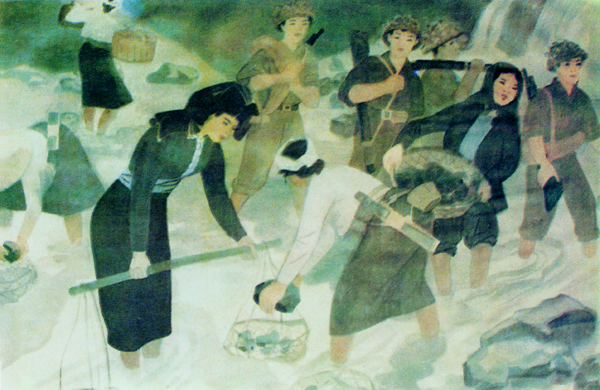
THANH NGỌC. Civilian labor of Điện Biên Phủ campaign. 1974. Silk. Collection of Ministry of Culture, Bulgaria.
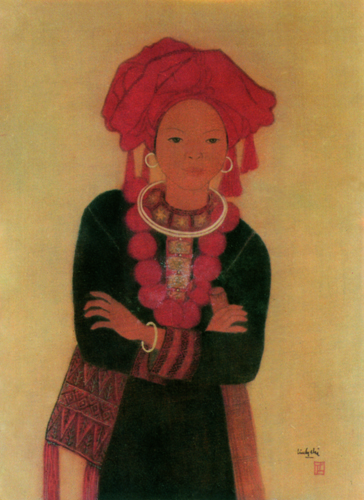
LINH CHI. A Yao girl. 1981. Silk. Việt Nam Fine Arts Museum
If we talk specifically about Asian materials, silk almost dominated Vietnamese painting throughout the 1930s, before the experiments with lacquer painting achieved complete success at a major exhibition in December 1940 (Exhibition of the Association of Indochina Painters).
The last exhibitions named FARTA, Salon Unique and of Indochina Fine Arts College in 1944 can be considered the end of the Indochina Fine Arts Period, and certainly, that was also the first period of modern Vietnamese fine arts in general and of Vietnamese silk painting in particular.
Four Vietnamese painters living in France
The first person to settle permanently in France, as early as 1931, was Mr. Vũ Cao Đàm, a talented sculptor, who later became famous as a painter who created a world of painting called “Oriental Legend”. In Paris, he began painting silk quite early, submitting his works to the galleries “Independent Artists” and “Autumn”.
During World War II, the scarcity of materials forced him to temporarily abandon sculpture and switch to painting. In 1946, he opened an exhibition of silk paintings, which was praised by Jeannine Auboyer in the magazine “France Illustration”.
Coming from a devout Catholic family, the spirit and emotions in Vũ Cao Đàm’s silk paintings also carry nuances of Christian art, especially in the themes of maternal love and portraits of young women, noble, somewhat mysterious, but close, warm, not too cold and distant.
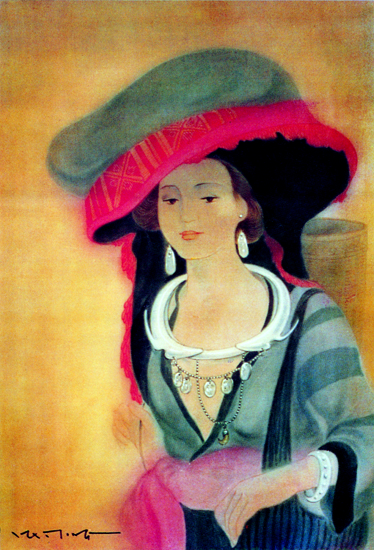
MAI LONG. Highland young woman. 1991. Silk
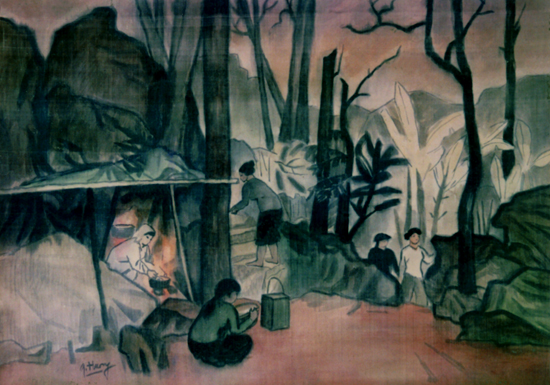
VŨ GIÁNG HƯƠNG. Fireplace in an afternoon of Trường Sơn. 1993. Silk. Việt Nam Fine Arts Museum
A few years after Vũ Cao Đàm, Lê Phổ and Mai Thứ went to France in 1937, and had stayed there ever since.
While still in Việt Nam, Lê Phổ initially painted silk with classical tastes (see illustration Part I). After his trip to China in 1934, his silk paintings, young women and still lifes, had echoes of ancient Song and Ming paintings. In France, in the first period (before 1945), he unusually blended Christian art and Buddhist devotional art, especially a bit austere since his spirit was affected by World War II. In the following romantic period, he mainly painted in oil, integrating ancient Chinese painting and post-impressionist painting.
With silk, Mai Thứ was more destined than anyone else. From a masterful oil painter, in France, he devoted all his time to silk painting.
In 1964, he held his first large solo exhibition with the theme “Children of Mai Thứ”, which was chosen by publishers to be printed in popular versions around the world. In 1968, he held his second exhibition with the theme “Women through Mai Thứ’s vision”. The third exhibition, in 1974, had the theme “The world of Mai Thứ”.
Mai Thứ harmoniously combined the quintessence of the East and the West and was somewhat influenced by Persian and Indian miniature art. His silk paintings were often small, even very small, full of poetry, profound, mysterious but fresh, brilliant, gentle but humorous. He also made a documentary film about silk painting techniques.
Of the four people in France, Lê Thị Lựu went to France last (1940), right during the war. Her most beautiful silk paintings were created in the 1950s: portraits of young women, children, motherhood, mountain girls, classical style mixed with impressionism, with a charming freshness.
There is another artist, Mr. Trần Phúc Duyên, who moved to France in 1954 and lived mainly in Switzerland. He focused on lacquer but also painted silk, with strong, vivid colors like dyes. In terms of visual concepts, he was greatly influenced by Nguyễn Tiến Chung.
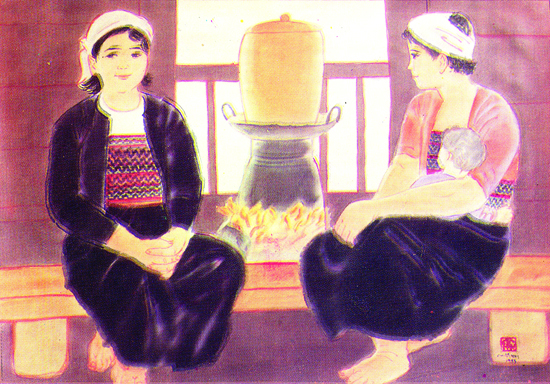
NGUYỄN THỤ. By the fireplace. 1983. Silk
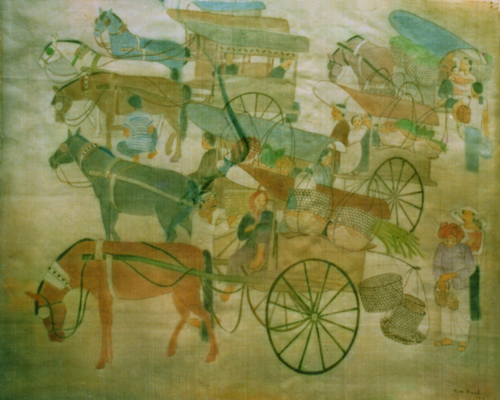
KIM BẠCH. Horse carriage station Bà Điểm. 1987. Silk
1945-1975 period
In any period, silk painting has never lost its position, but it can be said that silk has never had a position as almost exclusive as in the 1930s.
During this period, like the general history of modern Vietnamese painting, the progress of silk painting can also be divided into two stages: 1945-1954 and 1954-1975.
(Due to limited documents, this article mainly presents a brief overview of the development of silk painting in the North and hopes that other researchers will supplement the documents on silk painting in the South).
– Period 1945-1954: During the August Revolution and the nine-year resistance war against French colonialism, artists continued to paint silk paintings, although less than in the previous period. For example, in notable exhibitions, especially in national art exhibitions (1946, 1948, 1951, 1954), silk paintings were present as well as awards for silk paintings. Silk painters began to change their emotions to direct silk towards the real life of production and fighting at that time. In big cities like Hà Nội and Sài Gòn, the number of silk paintings painted in this period was also increasingly discovered.
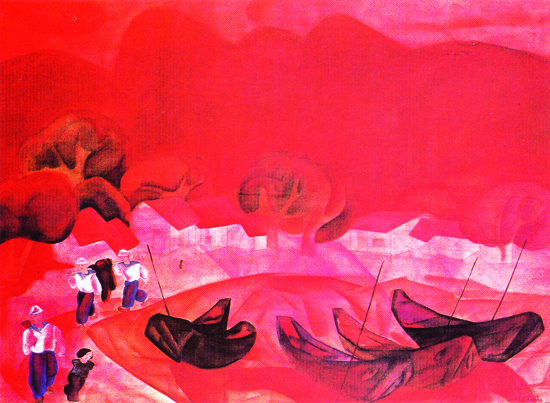
LƯƠNG XUÂN ĐOÀN. Afternoon in Hòn Tre island. 1980. Silk. Việt Nam Fine Arts Museum
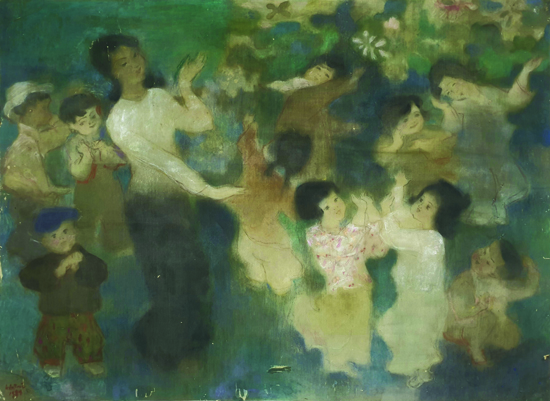
SƠN TRÚC. Dance lesson. 1974. Silk
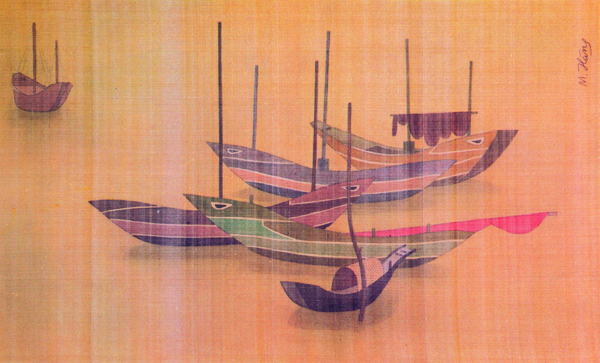
HOÀNG MINH HẰNG. The dock. 1994. Silk
– Period 1954-1975: Besides some artists from Indochina Fine Arts Period, some of the first new artists to succeed with silk paintings were the artists of the Resistance Class (1950-1954), Tô Ngọc Vân Class (1955-1957) and the following classes of Việt Nam Fine Arts College. Phan Thông with the silk painting “Marching in the rain”, harmonized the ink painting style and the narrative painting style into an extremely poetic lyrical realism style. Tạ Thúc Bình painted “Contribute rice to granary” depicting countless vivid details like the simplification of woodcuts. Trọng Kiệm had “Visiting the house”, Ngô Minh Cầu had “Come to the countryside of production”… Trần Đông Lương completed his three most important silk works in just one year -1958: “Doctor – Labor Hero Phạm Ngọc Thạch”, “Embroidery team” and “Youth”, demonstrating an unusual ability in the art of transferring “pure” drawings onto silk to create paintings with a painterly character…
Linh Chi brought silk into deep tones with ripe colors like ancient silk paintings, while Mai Long entered a “beautiful” style with the sweetness of the shapes and decorative colors, sometimes using elements of Cubism…
Vũ Giáng Hương painted scenes of labor and fighting activities into large-scale spatial compositions: “Fishing cooperative returning” and the “Trường Sơn” series. Thanh Ngọc had a silk painting “Civilian labor of Điện Biên Phủ campaign”.
In particular, Nguyễn Thụ can be considered one of the most outstanding representatives of silk painting since Nguyễn Phan Chánh. From a series of colored and black-and-white woodcuts created in the 1960s, he developed the graphic language of engraving on silk paintings to gradually become more unique than ever in the 1970s, 1980s, 1990s, in the main themes of nature, people and life in the highlands of the Northwest and Northeast… In the South, the founder of the Sài Gòn National Fine Arts College in 1954 – Mr. Lê Văn Đệ – also paid great attention to silk painting, as a factor promoting the art of silk painting in the South. Silk painters in the South during this period include Tú Duyên (a veteran painter, also very famous for his prints), Ngô Văn Hoa, Trương Văn Ý, Nguyễn Hoàng Hoanh (who painted silk paintings in the style of mise en pages), Nguyễn Thị Tâm, Hiếu Hạnh, Đỗ Thị Tố Phượng, Đỗ Thị Tố Oanh…
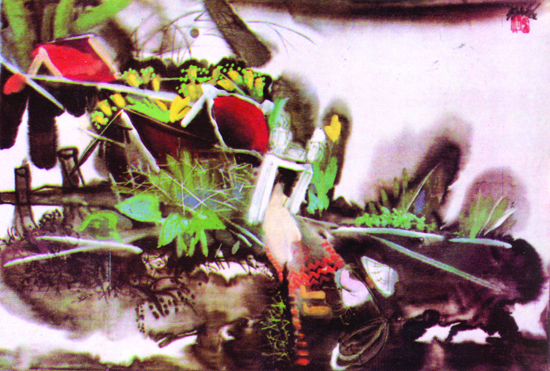
ĐỖ PHẤN. View of countryside. 1992. Silk
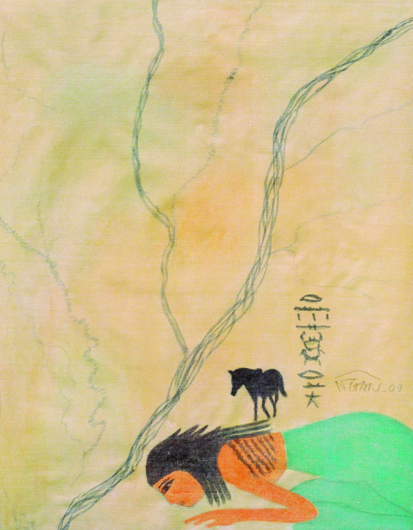
HOÀNG THÚY NGÂN. The dream. 2009. Silk
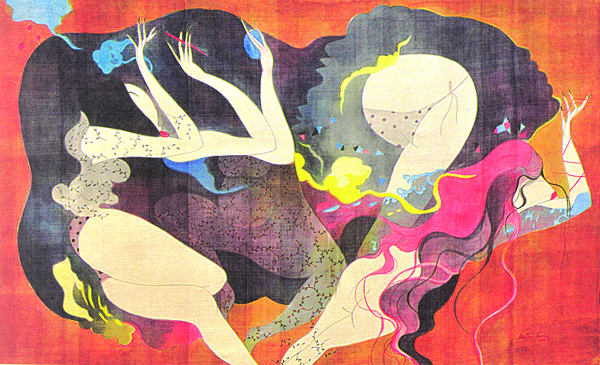
BÙI TIẾN TUẤN. Night of songs. 2017. Silk
Period from 1975 to present
In the early period before renovation period, Vietnamese painting was overwhelming first of all in oil painting, because this was the point of strongest release of external influences, especially from modern Western “bourgeois” art, even though it was not until the mid-1980s that socialist realism was truly completed.
A number of painters from previous periods also returned or began to be interested in silk painting, such as: Công Văn Trung, Nguyễn Văn Tỵ, Lê Quốc Lộc, Sỹ Ngọc, Tạ Thúc Bình, Trần Duy, Năng Hiển painted beautiful scenes; Trần Lưu Hậu painted landscapes, Lê Huy Hòa painted young women; Huỳnh Phương Đông, Thanh Châu painted battles; Minh Mỹ, Huy Oánh, Mộng Bích, Kim Bạch, Hà Cắm Dì painted daily life, portraits, still lifes, etc.
New generation silk painters such as Quách Đại Hải, Lương Xuân Đoàn, Lê Anh Vân continued to paint “theme paintings” but in a modern style. Đỗ Phấn, Hoàng Minh Hằng, Chu Thị Thánh, Mai San, Đỗ Thị Ninh, Lê Kim Mỹ, Sơn Trúc each brought a strange space to silk paintings.
In the 1980s, silk paintings were somewhat commercialized, becoming a souvenir, painted very roughly, cliched, causing a stagnation that seemed difficult to overcome.
Over the past 10 years, silk paintings have begun to have young artists making efforts to explore and innovate. Although there has not been enough time to affirm its value, it is clear that through these explorations and innovations, silk has also begun to have significant changes in the way of organizing the perception of painting, which is very much worth looking forward to.
In principle, with any material, artists can paint figuratively or abstractly. Some ancient silk paintings that have been “abstracted” by time look even more mysterious and charming. Choosing the right material for the needs and expressive ability is also a sign of talent.
However, like any other material, silk is always and always more or less depend on “classic”, it governs both the painter and the viewer. The viewer’s approach to the work is something the painter must always think about, because there is no art without a viewer. As a traditional Asian painting material, the prerequisite for silk painting is probably its “immateriality”, avoiding “heaping”. Some recent painters have brought silk painting into a materialistic and naturalistic form of description, or in other words, have “materialized” silk painting – which goes against the nature of silk. After all, no matter how strange the technique, or no matter how novel the foreign influence – is still the same as in the past, never able to completely resolve the content of art. The new, the good in form must come from itself, from the emotions, from the “inner essentials” of the artist. “When you put aside the external rules, you must have a very strong internal rule. If you speak correctly about the current surrounding emotions, even if it is awkward and unrhyming, it will still sound right” (Nguyễn Đình Thi).
Written by Hà Thái Hà, posted on the website of Fine Arts Magazine
http://tapchimythuat.vn/my-thuat-hien-dai-viet-nam/90-nam-tranh-lua-viet-nam-may-chu-giai-ve-lich-su-ky-ii-cac-thoi-ky-va-cac-hoa-si/