

The special memory
In “Autobiography 1947”, writer Tô Hoài recorded a special memory of the Party admission ceremony for several artists and writers in the early years of the resistance war, including writer Nam Cao, painter Trần Đình Thọ, and a printing worker named Phúc Mơ. The scene is described movingly:
“We were in the hut. Painter Trần Đình Thọ made a large hammer and sickle symbol on the bamboo wall. On the floor was a bamboo tube with wild flowers… Phúc Mơ raised his hand and swore absolute loyalty to the Party, tears welling up, just as Nam Cao had done.”
The space for the ceremony was just a hut in the forest, the hammer and sickle symbol drawn on the bamboo wall, a few wild flowers in a bamboo tube – everything was very simple. But it was precisely in this simplicity that a sacred and moving atmosphere emerged. In particular, Phúc Mơ’s words that night reopened a painful historical memory:
“Brother, I miss my parents, it was sorrowful, they both died in that famine.”
With a few lines, Tô Hoài evoked memories of the 1945 famine, one of the greatest tragedies in modern Vietnamese history. Phúc Mơ’s personal loss simultaneously reflects the fate of millions of Vietnamese people during those years.
Therefore, the passage is not simply a record of a Party admission ceremony for artists and writers, but also carries the special romantic tone of the resistance era; amidst hardship and loss, the people still chose the path of dedication, placing their faith in the ideals and future of the revolution.
For the young painter Trần Đình Thọ, it is one of the special memories that will never fade in his mind throughout his life and career. Those memories settled into layers of emotion, waiting to be transformed into lines and colors on the canvas, becoming the source of inspiration for his important works in the years of peace that followed.
Graduating from the class of 13 (1939-1944) of Indochina Fine Arts College, painter Trần Đình Thọ was one of the artists who joined the revolution early in the years of the resistance war. From 1946 to 1953, he went to the resistance zone, serving the revolution, while continuing to sketch and record life during the resistance. The 1947 Party admission ceremony in Tô Hoài’s story shows that he had already joined the ranks of the Party early on.
After nine years of the resistance war, peace was restored in the North in 1954. From the war zone, painter Trần Đình Thọ along with other artists and writers returned to Hà Nội. Besides a small backpack which contained personal belongings, there were sketches and drafts he created during the war years. More importantly, his soul held a rich storehouse of memories about war, labor, comradeship, and profound life experiences, and especially the value of peace.
The hearts’ sunshine of happiness
Regardless of the subject matter, a valuable work of art must always contain and convey messages and themes that bear the mark of its time. In his work “Sunshine of homeland” (1957, oil on canvas), painter Trần Đình Thọ depicted a landscape bathed in the peaceful sunlight of a Northern Vietnamese village, specifically the coconut village of Yên Sở (Hoài Đức, Hà Tây).
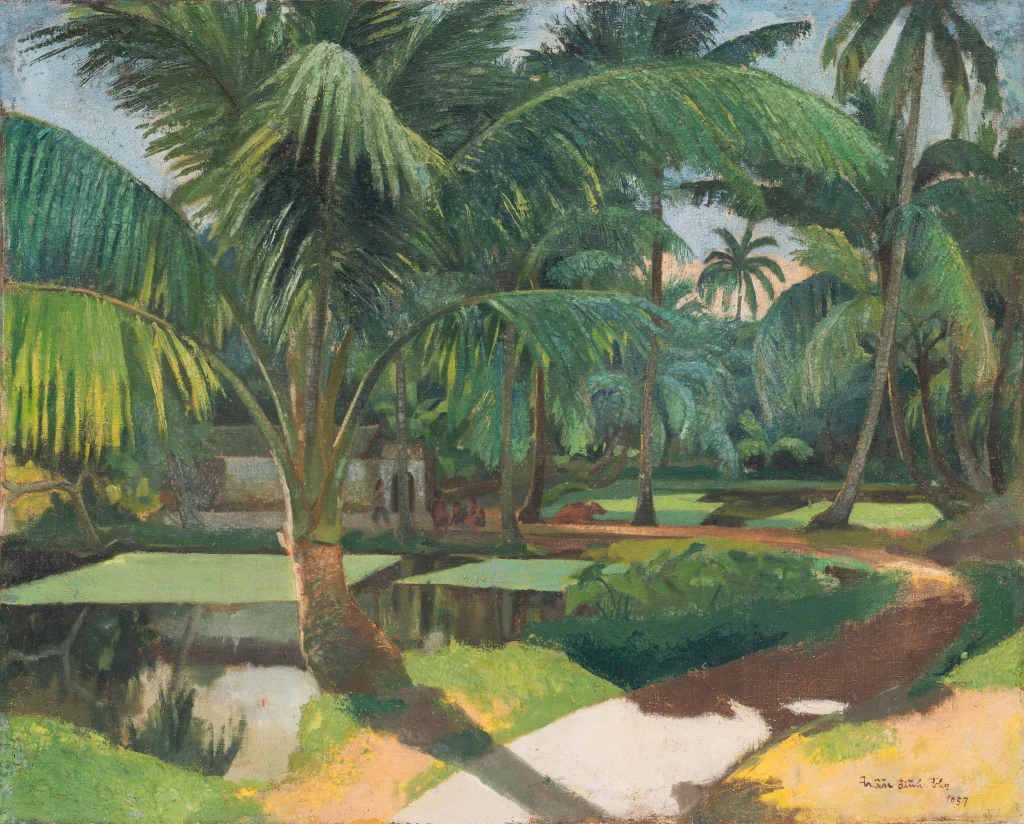
The afternoon sun make a golden glow on the small road. Bright, warm sunlight filters through the tall coconut trees, touching each green frond, causing them to shimmer with sparkling points of light. The rows of coconut trees cast long shadows on the ground, each frond bathed in sunlight, swaying gently in the breeze.
At the foot of the coconut trees, the pond’s surface is calm and still like a green mirror. Neatly arranged patches of pistia lie flat, like green mats gently placed on the clear water. In the distance, a few children play beside a buffalo resting deliberately by the road.
On the horizon, a small corner of the vast, deep blue sky stretches out, with thin, pinkish clouds of the afternoon drifting silently. The entire space seems bathed in golden sunlight on the lush green vegetation, creating a warm and peaceful atmosphere…
Before the artwork, the viewer feels happy, relaxed, and at ease. A sense of balance and inner peace arises. This is precisely the mood the artist felt when creating this work. He didn’t simply recreate a beautiful landscape; it was his feelings, thoughts, and perspective on the society he lived in. To fully express his emotion at the peaceful life, he skillfully combined academic, standard artistic techniques with genuine emotion in his creation. And this is clearly evident; from the coherent and concise overall composition to the impressive and subtle lighting.
With inner stability and a belief in the transformation of the country under the Party’s guidance, the towering coconut trees were depicted, their sturdy trunks bathed in brilliant light. On the calm surface of the pond, patches of green pistia appear neatly arranged, reflecting the surrounding landscape as a subtle metaphor for the orderliness, stability, and prosperity of the new rural life. A gently curving dirt path leads between the two banks of the pond, towards a familiar archway, with a cozy roof peeking out from behind. These simple details connect to form a harmonious whole, creating a sense of peaceful balance throughout the space.
This is the clearest expression of the artist himself, and of the people, with their belief in the stability and peace that the revolution brought in the early years of the era.
The work is not merely a depiction of a specific rural landscape, but also a reflection of a historical mindset. Artist Trần Đình Thọ created the painting in 1957, when the North of Việt Nam was entering the early years of peace after long stages of poverty and turmoil before the August Revolution; after the hardships and brutality of nine years of protracted resistance; and when society had stabilized after land reform. In that context, the entire Vietnamese nation began to deeply feel the happiness of life in peace. For artist Trần Đình Thọ, the work is a synthesis of social reality, optimism, and even romanticism stemming from his faith and love for life.
Millon
Duplex – April 11th 2026
HỒN VIỆT: NGHỆ THUẬT XƯA VÀ HIỆN ĐẠI
L’ÂME DU VIETNAM: ARTS ANCIENS ET MODERNES
Contact:
info@millon-vietnam.com
+84 (0)7 06 43 06 88
March 11th 2026
Written by Viet Art View