

Artist Tôn Thất Đào* was born on October 15, 1910, in Phú Cát village, Huế, into a family with a tradition of dignitary of the Nguyễn Dynasty. His father, Tôn Thất Tu, was a dignitary in the court at that time. Growing up in the cultural environment of the imperial court and the rich artistic traditions of the ancient capital, Tôn Thất Đào was nurtured from an early age by the refined environment with the distinctive cultural depth of Huế. These factors contributed to igniting in him a passion for artistic creation from a young age.
After completing secondary school, Tôn Thất Đào decided to pursue a professional art career by enrolling in Indochina Fine Arts College, class 8 (1932-1937), he studied alongside figures who later became prominent artists such as Lương Xuân Nhị, Đỗ Đình Hiệp, Nguyễn Văn Khanh, Nguyễn Thị Nhung, Nguyễn Thâu, Nguyễn Văn Thiệu, and Lê Yên. His time studying at this prestigious art college not only marked a significant turning point in his life but also shaped his unique creative style, imbued with the distinctive Huế character.
Among the few Indochina students born in Huế, such as Võ Lăng, Trần Duy, and Thân Trọng Sự, and a number of renowned artists of that time, Tôn Thất Đào was perhaps the most special. He had the honor of directly drawing portraits of Queen Nam Phương and also served as a painting teacher for Crown Prince Bảo Long. This demonstrates his professional competence, artistic position, and the special trust he received from the royal family at that time.
From his graduation at Indochina Fine Arts College in 1937 until he passed away in 1979, almost his entire creative journey was intertwined with Huế. For decades, Huế became a constant source of inspiration throughout his artistic career. From the scenery of Hương River, Ngự Mountain, moss-covered tiled roofs, mausoleums, temples, to the life of the people of Huế, all have been elegantly and nostalgically incorporated into his works.
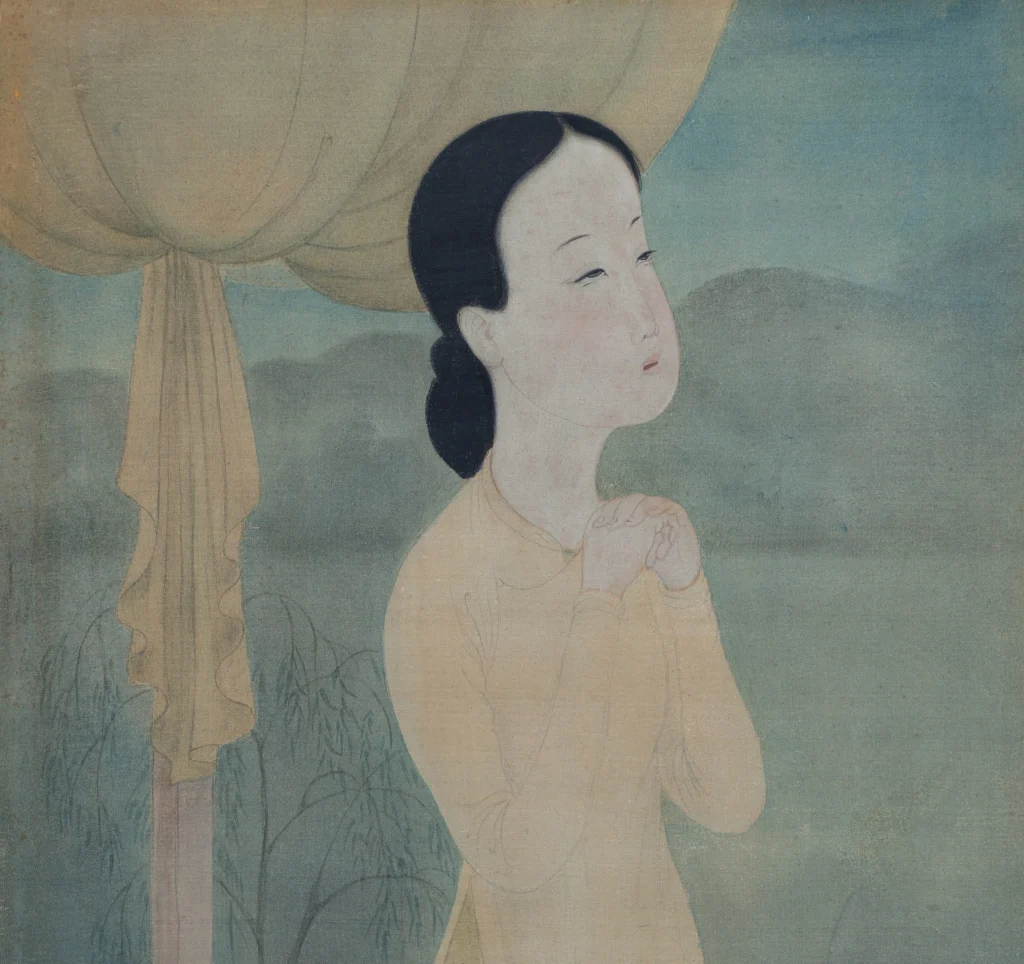
In recent years, Tôn Thất Đào’s works have increasingly attracted the attention of art lovers and collectors. In particular, a number of his silk paintings created in the 1930s have consistently achieved impressive prices at auctions. For example, the painting “The Musicians” (silk, 1936) sold for a price of 227,188 USD in 2021. Most recently, in April 2026, an untitled painting of two girls (silk, 1936) achieved a price of 209,983 USD. Both works were created in 1936, before Tôn Thất Đào graduated from Indochina Fine Arts College. These results demonstrate the appeal and artistic value of Tôn Thất Đào’s works in the market today.
On June 27, 2026, Millon will hold a Paris-Hanoi duplex auction with the theme “L’âme Vietnamienne: Maîtres de la Modernité”. Notably, this marks the first time seven oil paintings by Tôn Thất Đào have appeared simultaneously in a single auction. The event not only broadened perspectives on his creative career but also contributed to showcasing the rich variety of medium and artistic values he possessed in the history of modern Vietnamese art.
Among these seven works, two depict the mausoleum of Thiệu Trị, two depict the mausoleum of Tự Đức, two depict the citadel, and one is a still life of flowers. It is evident that the artist did not choose perspectives that depicted architecture, but rather directed his eyes towards landscapes that evoked a solemn atmosphere, a tranquil beauty, and the gentle charm characteristic of Huế. From the imperial palace, the citadel, mausoleums, pavilions, lotus to still lifes of flowers or images of women in Huế… although created several decades apart, they are always imbued with Tôn Thất Đào’s deep affection and love for Huế.
The two works “Courtyard of Ngưng Hy Palace, Thiệu Trị Mausoleum” and “A corner at Thiệu Trị Mausoleum” were created in 1939, two years after Tôn Thất Đào graduated from Indochina Fine Arts College and returning to Huế.
In the work “Courtyard of Ngưng Hy Palace, Thiệu Trị Mausoleum”, Tôn Thất Đào chose a direct view from the main gate towards the mausoleum courtyard, where rows of stone statues of elephants, horses, and attendants appear in silence. The space opens up in depth, creating a sense of solemnity and continuity, and also a quiet, tranquil atmosphere. These statues, standing there through the changes of time, not only play a role in the overall architecture but also serve as witnesses to history.
![[Bài viết] Tình yêu thương với Huế trong tranh của họa sĩ Tôn Thất Đào](https://vietartview.com.vn/wp-content/uploads/2026/06/Ton-That-Dao-san-dien-Ngung-Hy-1024x827.webp)
Meanwhile, in “A corner at Thiệu Trị Mausoleum”, the artist explored a completely different perspective. From a high point of view through the trees, the row of statues appear small and inconspicuous, yet still show complete form and detail. This approach makes the scene feel distant and suggestive rather than descriptive. Nature seems to envelop the entire architecture and historical relics, causing the stone statues to lose their majestic appearance of dynastic power and blend into the tranquility of the landscape.
![[Bài viết] Tình yêu thương với Huế trong tranh của họa sĩ Tôn Thất Đào](https://vietartview.com.vn/wp-content/uploads/2026/06/Ton-That-Dao-mot-goc-Thieu-Lang-508x1024.webp)
In the two works, people are not directly present. There is only the sense of the artist’s presence as a quiet observer. And the viewer enters the work in a similar state, as if standing in that space to feel the silence, the solitude, and the depth of time still lingering in the landscape. The characteristic blend of green and yellow-brown hues in the paintings further accentuates this spirit. The layers of color, the gently spreading shadows of leaves, and the warm, subdued light make the entire scene seem shrouded in a layer of old time.
Tôn Thất Đào’s brilliance lies in his ability to create completely different emotional states simply by changing the point of view within the same location. While “Courtyard of Ngưng Hy Palace, Thiệu Trị Mausoleum” evokes a sense of majesty and solemnity with a direct composition of sturdy, clearly defined, and ceremonial stone statues, “A corner of Thiệu Trị Mausoleum” makes the entire space softer and more poetic. From a high vantage point, peering through the foliage, the statues now appear only faintly amidst nature, causing the impression of power to gradually fade into the distant and silent feeling of time. Nature seems to envelop the entire architecture, transforming the stone statues from symbols of power into silent testaments to a bygone dynasty.
This change in perspective guides the viewer’s emotional state. This demonstrates the particularly important role of the artist in shaping the visual approach and psychological reception of the work. The same view, but the choice of viewing position and composition, is enough to completely change the feeling the work evokes.
From Thiệu Trị Mausoleum, we then visit Tự Đức Mausoleum through two works: “Season of lotus at Tự Đức Mausoleum” created in 1940, and “Strolling by the lotus pond Lưu Khiêm” created in 1961.
It could be said that “Season of lotus at Tự Đức Mausoleum” is one of the most poetic and romantic works in Tôn Thất Đào’s paintings on the theme of mausoleums. The entire scene is covered in a harmonious blend of vibrant and gentle colors, the green of the vegetation both on land and water. The pink of the lotus and the reddish-brown of the architecture blend together in a soft feeling characteristic for Huế.
![[Bài viết] Tình yêu thương với Huế trong tranh của họa sĩ Tôn Thất Đào](https://vietartview.com.vn/wp-content/uploads/2026/06/Ton-That-Dao-mua-sen-Khiem-Lang-865x1024.webp)
Based on the landscape, the lotus in the painting is at its most beautiful, around the end of May to June, the time when lotus bloom profusely on Lưu Khiêm lake. The architecture appearing in the painting is most likely one of the three pavilions: Nhã Khiêm, Lạc Khiêm, or Tiêu Khiêm, built on Tịnh Khiêm island in the middle of the lake. This was originally a large artificial hill where the king had rare trees and animals for his enjoyment. On the lake, King Tự Đức often sat on boats named Tịnh Khiêm and Ổn Khiêm, cruising around the island to admire the scenery, read, and find peace amidst nature.
Because the three pavilions are located on the island, this space is rarely accessed, creating a sense of isolation and dreaminess. In the painting, Tôn Thất Đào did not emphasize the architecture but allows nature to encompass almost the entire scene, with the pavilion beside an old plumeria tree, the trees casting their shadows on the lake, and lotus in their most vibrant bloom.
It could be said that “Strolling by the lotus pond Lưu Khiêm” is one of the works that clearly shows the gentle, poetic beauty of both the scenery and the people in Tôn Thất Đào’s paintings of Huế. If “Season of lotus at Tự Đức Mausoleum” possessed a poetic beauty with the ancient temple architecture and surrounding nature as its central characters, then in this work, created twenty one years later, viewers could clearly sense the change in the artist’s emotional state of the scenery.
![[Bài viết] Tình yêu thương với Huế trong tranh của họa sĩ Tôn Thất Đào](https://vietartview.com.vn/wp-content/uploads/2026/06/Ton-That-Dao-dao-choi-ben-ho-sen-Luu-Khiem-798x1024.webp)
Looking at the two works together, we could easily recognize the similarities in space and the season. The lotus pond is still at its most vibrant, the water reflecting the trees and architecture in bright colors. However, while in “Season of lotus at Tự Đức Mausoleum” the scenery is almost entirely still, in “Strolling by the lotus pond Lưu Khiêm” the space seems more lively with the presence of people.
In this 1961 work, Tôn Thất Đào added a group of Huế women as a focal point, building new rhythm and emotion. Three graceful characters in áo dài appear in the foreground in different poses; two stand and it seems like they are chatting under the shade of a tree, while another girl sits gently leaning against the railing on the right. Further in the background, a small figure is faintly visible.
The composition of the work is built on spatial depth combined with a winding visual path, demonstrating Tôn Thất Đào’s ability to tightly encompass a multi-layered composition. From the group of women in the foreground, the eye follows the curve of the lakeside railing, gradually opening to a expanse of water covered with lotus. To the left, a large tree trunk envelops the midground and background, creating a solid focal point at the end of the curve before coming to the pavilion. This curve makes a very gentle sense of movement leading to the center of the composition, Xung Khiêm Tạ, with its full appearance of a beautiful architectural structure. Tôn Thất Đào chose a diagonal viewpoint so that viewers can clearly observe the elongated width of the structure and its reflection on the lake in front. Thanks to this approach, Xung Khiêm Tạ appears less majestic and more graceful, blending into nature. Further in the distance, faintly visible against the green backdrop, is perhaps the shape of one of the three pavilions on Tịnh Khiêm island, expanding the space into successive scenes.
What is special about this work lies in how Tôn Thất Đào transformed the role of architecture. While in his previous paintings of mausoleums, the scenery often evoked a sense of solitude and time standing still, in “Strolling by the lotus pond Lưu Khiêm”, architecture has become a part of life. The appearance of women in áo dài suggests that Huế has become more intimate and vibrant in the artist’s perception. But even with the added presence of people, what remains throughout is the very spirit of Huế: gentle, quiet, poetic with the beauty of memory.
After leaving the solemn space of the mausoleums, Tôn Thất Đào brought viewers back to the imperial city of Huế through two works: “The flagpole of Huế imperial city” (1940) and “The lotus pond in the imperial city of Huế” (1970). Similar to the paintings of Tự Đức Mausoleum, these two works were created three decades apart but still demonstrate consistency in Tôn Thất Đào’s aesthetic sensibility and affection for Huế.
![[Bài viết] Tình yêu thương với Huế trong tranh của họa sĩ Tôn Thất Đào](https://vietartview.com.vn/wp-content/uploads/2026/06/Ton-That-Dao-ky-dai-kinh-thanh-Hue-1024x738.webp)
If in 1940, the Flagpole of Huế imperial city was still a living part of the Nguyễn dynasty, bearing the imprint of a capital city existing in reality, by 1970, the Flagpole and the citadel had gradually taken on the appearance of an ancient capital, as the dynasty had become a memory. However, it is noteworthy that despite the changing historical context, Tôn Thất Đào’s feelings and perceptions for Huế seem to have remained unchanged. The space is still gentle, poetic, peaceful, and imbued with his deep affection.
This change lies in the artist’s approach to space when the history transformed.
In “The Flagpole of Huế imperial city” (1940), Tôn Thất Đào opened up a vast, captivating space encompassing Hương river, the plains in front, the distant mountain range behind, and the entire expanse of sky and clouds. The Flagpole appears as the center of the composition and the focal point. The entire landscape was almost devoid of human presence, giving the space a sense of vastness and emptiness. At that time, the Flagpole still belonged to the power sphere of the Nguyễn Dynasty, a national symbolic area that was difficult for people to access as a space for daily life. Therefore, Tôn Thất Đào’s perspective in this work is one of admiration from a distance. The Flagpole appears as a landmark of power standing firmly amidst the vast natural landscape.
Meanwhile, in “The lotus pond in the imperial city of Huế” (1970), the artist’s approach changed significantly. The Flagpole’s historical role was replaced; it was no longer the direct center but only faintly visible in the distance behind the lotus pond and the citadel system. The space now became more intimate and lifelike. The curved bridge, the water surface covered with lotus, and the image of two women in traditional áo dài walking leisurely by the lake give the scene a soft and familiar feel. While the 1940 work evokes the stillness and distance of a space of power, the 1970 painting depicts the Imperial City gradually becoming a part of life in Huế, accessible to the public for sightseeing and enjoyment.
![[Bài viết] Tình yêu thương với Huế trong tranh của họa sĩ Tôn Thất Đào](https://vietartview.com.vn/wp-content/uploads/2026/06/Ton-That-Dao-ho-sen-Hoang-thanh-1024x806.webp)
However, what is remarkable is that despite the changes in history and the evolving way people approach this space, Huế remains vividly portrayed with the same deep and poignant affection in the mind of Tôn Thất Đào. He consistently viewed Huế with the tenderness of personal emotion, not through the lens of change and transformation. This gives his works the feeling that time is moving very slowly, as if all the scenery silently exists within an unchanging realm of Huế’s memory.
After admiring the mausoleums, the imperial city, and landscapes in the vibrant lotus season of Huế, viewers are transported back to everyday life with Tôn Thất Đào through a poetic space in private home during the first month or the lunar new year.
![[Bài viết] Tình yêu thương với Huế trong tranh của họa sĩ Tôn Thất Đào](https://vietartview.com.vn/wp-content/uploads/2026/06/Ton-That-Dao-xuan-Quy-Ty-726x1024.webp)
At this moment, there are not the historical traces and the solemn depth of the ancient capital. Before us is a vase of dahlia in vibrant pink, purple, and yellow, at their most beautiful, arranged in a blue ceramic vase by an open window. Outside the window, lush vegetation and light stream into the space, evoking the feeling of spring sunshine. The entire work is constructed in a warm color scheme with shades of pink, yellow, blue, and light brown blending softly. The light is not too strong but spreads evenly throughout the space, making the vase appear gentle and vibrant. In particular, Tôn Thất Đào paid meticulous attention to each petal. The petals, with their full bloom and subtle nuances, make the dahlias not only decorative but also create a sense that Tôn Thất Đào had completely opened his heart to the world. He returned to his inner life, gentle and peaceful, appreciating the simple beauty of everyday life.
Through seven oil paintings created between 1939 and 1970, viewers not only see familiar scenes of Huế but also have the opportunity to enter Tôn Thất Đào’s inner world. From Thiệu Trị Mausoleum, Tự Đức Mausoleum, the Flagpole, the lotus pond in the Imperial City to a vase of dahlias during the early spring days, each work shows a consistent perspective of the artist on his homeland and life.
It is noteworthy that during those more than three decades, things have changed. Some spaces that once belonged to the dynasty gradually became relics. Places once distant from the daily lives of the people have gradually opened up and blended into the new rhythm of life. But in Tôn Thất Đào’s paintings, Huế seems to retain its inherent beauty. Not because the scenery remains unchanged, but because the artist always views his homeland with the same deep and gentle affection.
From his silk paintings depicting Huế maidens with elegant lines to his oil paintings of mausoleums, lotus, the citadel, and still lifes with flowers created many years later, Tôn Thất Đào has almost never strayed from his own aesthetic world. The medium might change, the brushwork might shift from subtle and restrained to richer and more unrestrained colors, but at the deepest level, his view of life remains consistent. It is a benevolent and loving perspective.
In paintings of Tôn Thất Đào, violent conflicts or extreme emotions rarely appear. He chose subjects close to his feelings: a row of silent stone statues under the shade of trees, a lotus pond in full bloom, a section of citadel bathed in the early sunshine, a figure of woman, or a vase of flowers placed by the window. Under his brushstrokes, these daily things become more beautiful because they are seen with affection.
Perhaps that is why, when standing before these works, viewers see not only Huế of mausoleums, lotus, or city walls. What remains is a feeling of a deeply beloved Huế, seen through the eyes of someone born in that land, raised with it, and who had spent almost their entire life cherishing and being attached to it.
Huế in Tôn Thất Đào’s paintings is not just about landscapes, architecture, or history; Huế appears as a part of the artist’s memory, a cherished realm always present in his soul. And therefore, the most beautiful value of these works, besides depicting the scenery of a place, is that they are very special because they preserve the love of a son for his homeland.
* Tôn Thất Đào (1910-1979) – Originally from Phú Cát, Huế. He taught drawing at Khải Định High School, Đồng Khánh High School, National School, Technical High School, Tín Đức High School, and Huế Model High School. He was awarded the Long Bội Tinh medal by King Bảo Đại (1942). In 1957, he founded and became the first director of the College of Fine Arts under the University of Huế. He also served as the Director of Huế Small Industry Promotion Center and a professor of painting at Huế Supplementary School of Education.
WRITTEN BY VIET ART VIEW
COPYRIGHTS BELONG TO VIET ART VIEW
![[Article] “Girl Tending Buffalo” by Nguyễn Phan Chánh](https://vietartview.com.vn/wp-content/uploads/2026/06/Nguyen-Phan-Chanh-co-gai-chan-trau-ava-1024x1024.webp)