

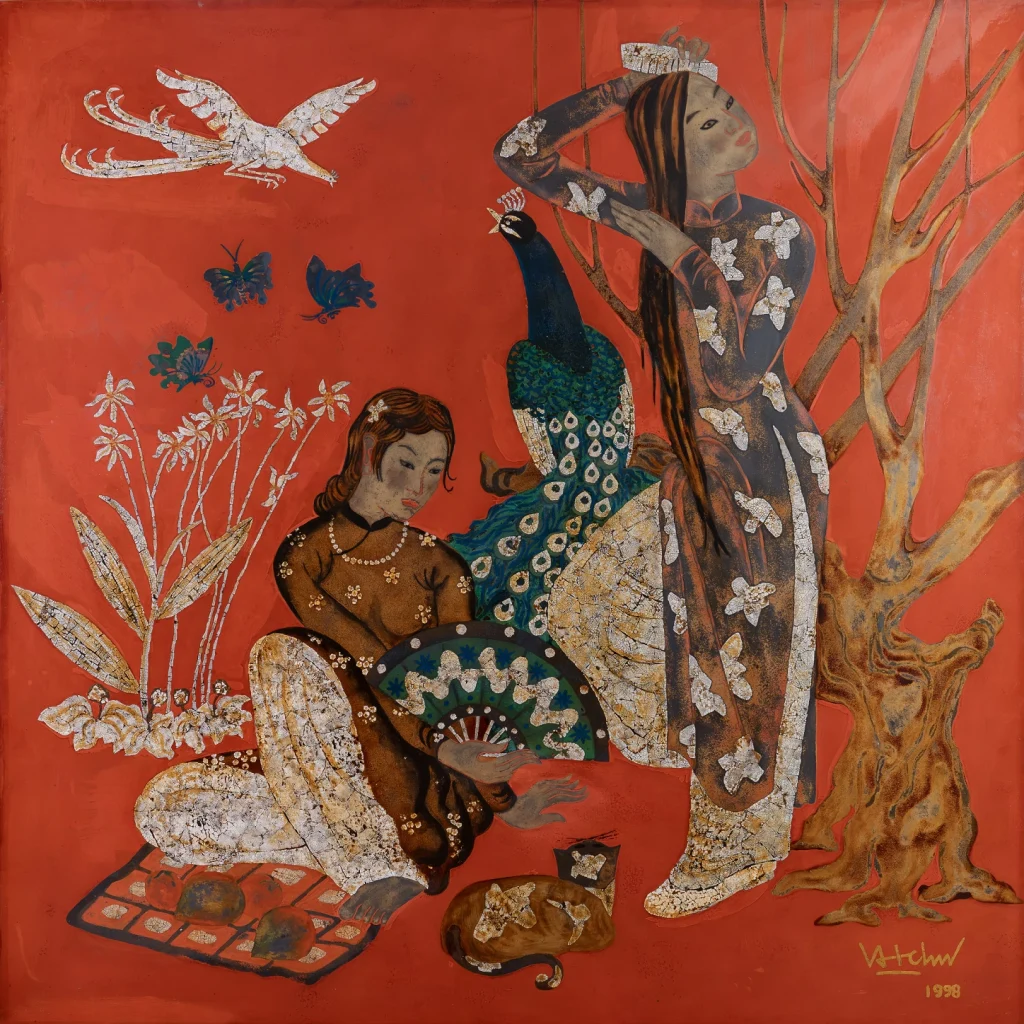
In the work Loosen up, artist Hoàng Tích Chù (1912–2003) invited the viewer into an artistic realm of serenity and auspiciousness. Set against a vibrant vermilion background, two Vietnamese women in áo dài serve as the central figures, surrounded by peacocks, phoenixes, butterflies, orchids, peaches, persimmons, a cat, and an ancient tree. One woman sits on a small woven mat, holding a fan, while the other stands by the tree, her hand raised to groom her hair. A peacock, its tail fanned out, perches on a dry branch; above, a phoenix soars with its head turned toward the women beneath, while three butterflies flutter near a cluster of orchids.
In the context of traditional Vietnamese life and culture, such symbolic motifs are often arranged according to a specific logic, one that does not necessarily adhere to physical reality. What, then, led Hoàng Tích Chù to select and combine these particular elements? Was he seeking to evoke themes of good fortune and prosperity within a scene of leisurely repose, or was he simply incorporating subjects he personally cherished? And what is it that transforms these familiar, iconic images into a painting with such a distinct, singular beauty?
An aesthetic sensibility grew over decades
Born into an intellectual family with a Confucian tradition of Kinh Bắc region, Hoàng Tích Chù, despite facing hardship, pursued a path in the arts, graduating as part of class 11 (1936–1941) of Indochina Fine Arts College. He began his career working with traditional lacquer; by the early 1940s, he had established a studio on Hàng Khoai Street in Hà Nội, while also gaining experience in the fields of decorative arts, design, and stage decoration.
Beside the formal education as a painter, Hoàng Tích Chù possessed a refined, romantic sensibility and a deep passion for beauty. The figure of woman, in particular, held a distinct place in both his life and his artistic work. During the time at Indochina Fine Arts College, his first model was Hoàng Diệu Trinh*, a girl from Hà Nội who would later become his life partner. For an art student, having such a close model not only facilitated his painting practice but also marked the beginning of an enduring connection between the real-life figures he knew and the subjects he depicted in art. From elegant, graceful girls to those captured in the midst of everyday life, Hoàng Tích Chù drew inspiration to explore the beauty of the human form, lines, attire, gestures, and various states of being.
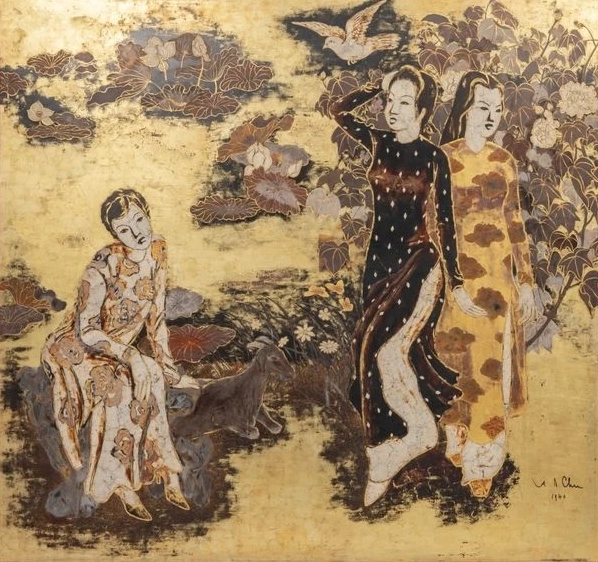
In 1940, while studying at Indochina Fine Arts College, Hoàng Tích Chù made the lacquer painting Elegant women in a garden. The piece features three women in áo dài, surrounded by flowers, foliage, butterflies, doves, and a small goat. These motifs are both linked to a specific living environment and imbued with cultural and aesthetic associations. From the very beginning of his career, the artist integrated the beauty of women, nature, and decorative features.
These images continued to appear in works from the final stage of the artist’s career. In a 1986 lacquer painting, a woman in áo dài sits beside a handbag, a potted plant, and some red fruits; she possesses delicate features, elongated eyes and lips of vermilion, with one hand raised toward her hair. In a 1989 piece, a similar woman, sharing the same facial features and posture, is placed within a setting filled with flowers, foliage, butterflies, a peacock, an unfurled fan, and peaches. In a 1991 work, the woman appears again, seated with her legs folded, holding a fan; she is accompanied by a cat, peaches, and butterflies fluttering around large clusters of blossoms. In a 1993 work, the artist depicted a woman sitting at an angle, her hair cascading down, her expression pensive, set beside red fruits and a window. In yet another piece, three women in áo dài are shown together in a garden setting, surrounded by traditional architecture, flowering plants, musical instruments, and objects evocative of refined, leisurely pursuits.
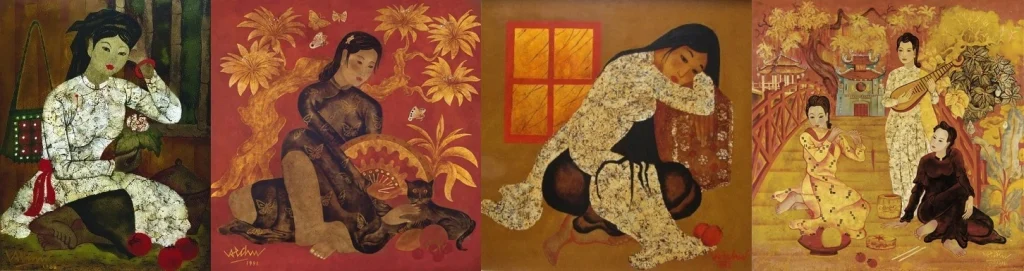
Observing these works, we could see that Hoàng Tích Chù frequently employed a consistent set of character types and motifs. Oval faces, elongated eyes, slender eyebrows, small lips, and dark hair, paired with recurring poses such as sitting with folded legs, tilting the head, raising a hand to the hair, or holding a fan are elements he integrated into various compositions. Furthermore, there is a recurring presence of flowers and foliage, birds, butterflies, round fruits, cats, and various objects that suggest an elegant, cultivated way of life. In these works, the fan serves not merely as a prop for posing, but as a highly decorative element; its sweeping, expansive curves introduce a rhythmic quality to the overall composition.
In this work dated 1998, these familiar motifs reappear within a new structure. The seated woman holding a fan bears a strong resemblance to the figure from the 1991 work, while the woman standing and combing her hair evokes gestures and postures seen in earlier pieces. Peacocks, phoenixes, butterflies, orchids, peaches, a cat, and the base of an ancient tree all appear against a background of vermilion. Yet, these figures are not simply repeated; rather, they have been selectively curated, repositioned, combined, and reorganized to forge entirely new correlation.
This continuity reveals a distinctive visual motif, a mark of Hoàng Tích Chù that was sustained and explored over decades. It demonstrates both a consistent aesthetic sensibility and a proactive approach to transforming familiar imagery. From the beauty of women, birds, and flora to the depiction of refined pastimes, Hoàng Tích Chù gradually constructed a unique artistic world, translating traditional motifs and everyday subjects into the distinct language of lacquer.
From auspicious symbols to a unique artistic world
In the work Loosen up, if we examine each motif individually, it is easy to discern meanings already well-established within Eastern culture. The peacock symbolizes magnificent beauty and affluence; the phoenix, a mythical bird, is associated with virtue, nobility, and peace; the orchid represents refinement and elegance; butterflies evoke spring and romance; and the peach signifies longevity and auspicious blessings.
However, if it were to rely solely on these conventional interpretations, any artwork employing similar motifs would inevitably carry the same meaning. The unique value of this painting, therefore, does not lie in a mere summation of these symbolic meanings, but rather in the relationships the artist had forged between the individual elements.
The peacock does not stand upon the ground; instead, it fans out its tail across the branches of a dry tree. The vibrant beauty of its plumage is juxtaposed against the stark, skeletal lines of the dry branches, creating an interesting correlation for the eye. Butterflies flutter above a cluster of orchids, linking the blossoms and the butterflies in a gentle, rhythmic motion. Above, a phoenix, with wings outstretched, a long, curved tail, and its head turned downward, appears to survey the entire scene beneath.
The simultaneous presence of the peacock and the phoenix also creates an interesting correlation: one is a real-world bird, while the other is a mythical creature born of human imagination; one rests upon a branch, while the other soars through the open air. Here, the beauty of the tangible, natural world and the beauty of an idealized vision coexist, not only in their physical placement but also in how they complement one another to expand the work’s meaning.
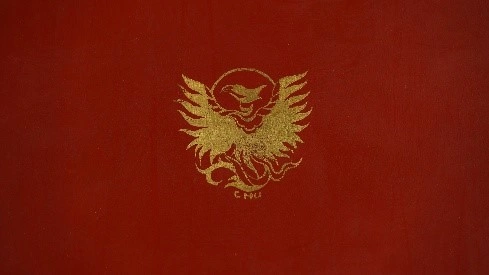
Furthermore, the image of the phoenix suggests a connection to the artistic practice of Hoàng Tích Chù. According to information regarding the Hàng Khoai studio, the artist chose the phoenix as a symbol for the studio as early as the 1940s, distinct from the character “Chu” that appears on his works. If the original logo design could be verified, the presence of a phoenix in the 1998 painting would serve as a significant lead for further research into the enduring legacy of a motif for which the artist might have held a special, decades-long affinity.
Beyond the images imbued with noble significance, elements such as a cat, a folding fan, a small woven mat, and peaches (or persimmons) evoke a sense of intimacy rooted in everyday life. The two women are not engaged in any specific narrative; their gazes and gestures do not converge toward one another. Instead, each appears to inhabit a private moment, resting at leisure, immersed in a world surrounded by the beauty of nature and auspicious blessings.
In this state, Hoàng Tích Chù’s refined, romantic sensibility finds its perfect expression: he need not depict opulence to convey prosperity, nor rely on classical allusions to signify good fortune. The motifs are chosen for their inherent beauty, for the richness of their forms and lines, and their capacity to evoke aesthetic pleasure. Through this, the artist made a realm that remains grounded in the familiar rhythms of life, yet is simultaneously enriched by an imaginative, idealized vision of beauty, inviting the viewer to contemplate and enjoy.
Decorative thinking and freedom in the organization of visual space
Another characteristic of Hoàng Tích Chù’s work is his frequent choice of a square or near-square panel format. By balancing the horizontal and vertical dimensions, this format allowed him to depict figures and details in various directions of movement, without being strictly bound by the requirements of a deep, three-dimensional space.
In Loosen up, two women form large, distinct shapes in contrasting poses. The seated figure appears compact, with the curves of her limbs and the fan she holds creating a self-contained structure. The standing figure has an elongated form; with her arms raised above her head and her hair cascading down, she introduces a sense of vertical rhythm. Although the two figures do not interact directly, they are intentionally linked by a central visual element, the peacock.
With its long, outstretched neck and fanned-out tail, the peacock creates a rhythmic form that bridges the two figures. Nearby, the base of an ancient tree, with branches reaching upward and spreading toward the right, acts as a counterweight to the soft, flowing curves of the women, the bird’s wings, and the surrounding flora. Butterflies, a cluster of orchids on the left, and a phoenix above further extend this rhythmic flow, guiding the viewer’s gaze across the entire surface of the work.
Despite the abundance of detail, the composition never feels cramped. The figures are arranged with varying degrees of spacing and density, interspersed with areas of vermilion-red background that serve both to separate and to connect the elements within this stylized, symbolic space. This reflects a distinct, deliberate decorative sensibility, a mark of Hoàng Tích Chù’s approach. His decorative style is not merely a matter of patterns, motifs, or traditional iconography; rather, it is embedded in the very way the artist organized lines, forms, color and negative space. It is precisely thanks to this freedom that the figures, which might otherwise seem to belong to entirely different realities, come together to form a harmonious composition, possessing its own rhythm and order.
A vibrant vermilion dominates nearly the entire surface. Against this red backdrop, areas of black, brown, and deep blue interspersed with bright highlights and the white tones of inlaid eggshell are arranged according to a play of light and shadow, serving both to define color and to sculpt form. These elements manifest as expansive areas, on garments, a fan, or the wings of a phoenix, as well as intricate patterns, delicate lines, and tiny dots adorning peacock feathers, butterfly wings, and floral motifs, creating a rhythmic distribution of light across the surface. Set against deeper, more subdued tones, these highlights accentuate the forms, establish a sense of rhythm, and guide the eye. The contrast between the vast vermilion expanses and the richly detailed imagery enhanced by the intricate patterns and the distinctive tactile quality of traditional lacquer, imbues the work with a beauty that is at once magnificent and harmonious.
The realm of peace
From Elegant women in a garden (1940) to Loosen up (1998), we could discern a continuity in Hoàng Tích Chù’s aesthetic sensibility regarding the beauty of women, nature, and motifs rooted in traditional culture. Over nearly six decades of artistic practice, these familiar elements had been continuously transformed through diverse compositional structures. In Loosen up, they were brought together within a highly stylized, symbolic space, a setting where the beauty of everyday life merges with the realm of legend.
Although the work incorporates a multitude of figures, each carrying its own symbolic significance, Loosen up avoids any sense of ostentation; instead, it evokes a world of elegance, harmony, and tranquility. Two women engage, at a leisurely pace, in the simple activities of daily life, surrounded by peacocks, phoenixes, orchids, butterflies, peaches, and an ancient tree. While each element possesses its own distinct beauty and character, they collectively foster a profound sense of serenity, peace, and auspiciousness.
Viewed through the lens of Loosen up, Hoàng Tích Chù’s refined, spirited, and romantic temperament is revealed not merely in his passion for beauty, but in the creative freedom with which he constructed an artistic world governed by his own unique aesthetic vision. Through a highly decorative composition, fluid lines, a palette dominated by vermilion, and the distinctive tactile quality of traditional lacquer, he had transmuted familiar motifs into a painting that is at once magnificent and intimate, rich in symbolism, yet deeply imbued with the emotions of everyday life.
Thus, the profound value of Loosen up lies not merely in the beauty of its imagery and visual language, but also in the spiritual realm that Hoàng Tích Chù aspired to, a state where individuals could repose in tranquility amidst all that is beautiful and wholesome. This sense of serenity, found within the moment of rest, serves as both the core spirit permeating the entire work and an aesthetic value crafted by Hoàng Tích Chù through his own unique painterly language.
* According to Mr Hoàng Tích Trí, son of the artist Hoàng Tích Chù, the two figures in the work Loosen up were modeled after Hoàng Diệu Trinh, the artist’s wife, and her sister.
HOÀNG TÍCH CHÙ (1912 – 2003)
Loosen up, 1998
Lacquer
99 × 99 cm
Millon
L’Âme du Vietnam – Les harmonies éternelles
7th November 2026
Contact:
info@millon-vietnam.com
+84 (0)9 36 01 56 89
WRITTEN BY VIET ART VIEW
COPYRIGHTS BELONG TO VIET ART VIEW