

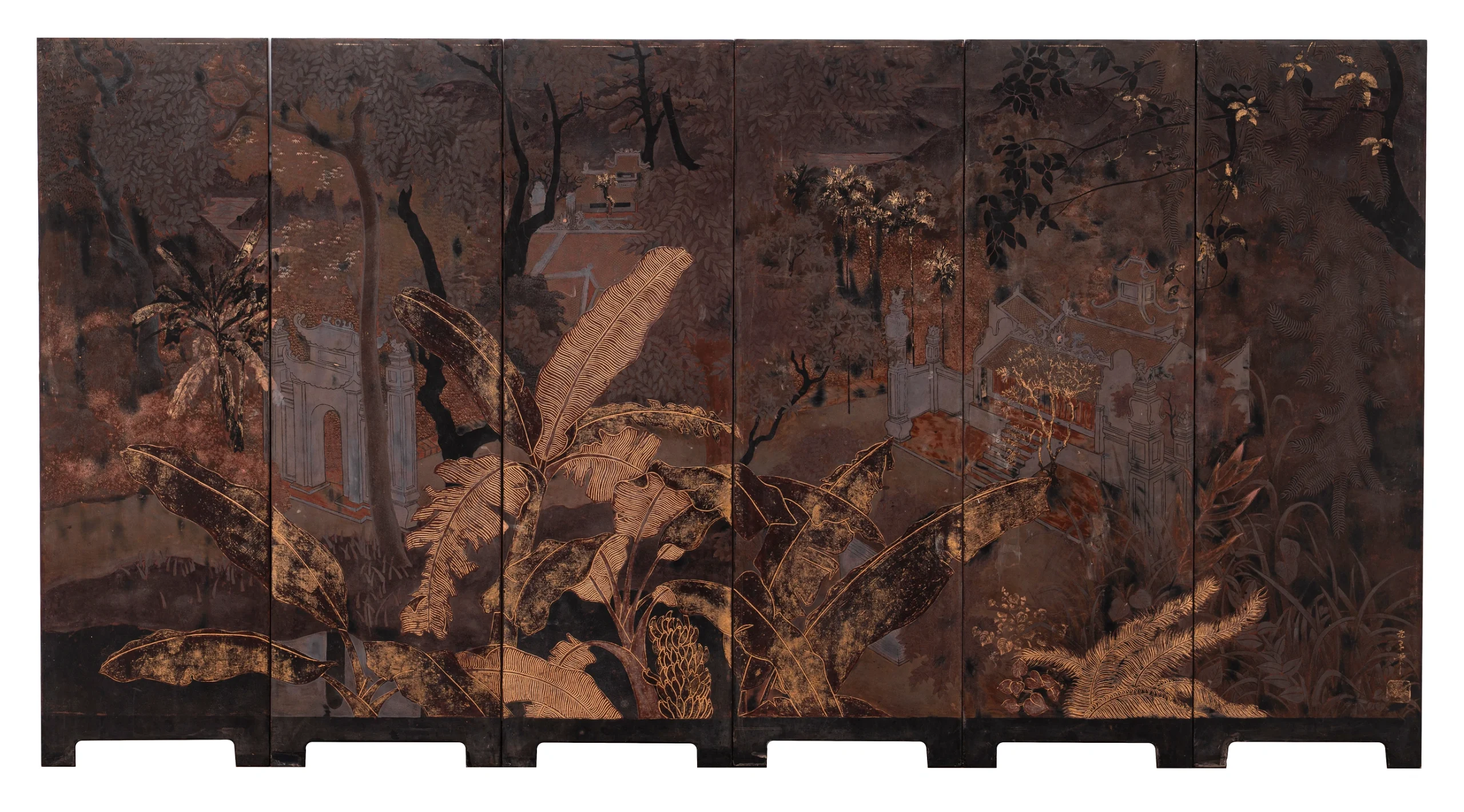
In the creative career of Phạm Hậu, the landscape-themed folding screens from his early period hold a special place. They fully showcase his talent through the core qualities that defined his reputation: a masterful command of traditional lacquer, love for the beauty of the homeland, keen powers of observation, a rigorous approach to composition, and an aesthetic sensibility that is elegant, magnificent, yet restrained, and sophisticated.
For a long time, Phạm Hậu had consistently focused on subjects such as nature, flora, rural villages, architecture and temples. This reveals a steadfast aesthetic preference: seeking beauty within the world around him, in scenes that are familiar, intimate, and simple. His six-panel folding screen, Landscape of midlands in the North, is one such work. It is also exceptionally rare, as it emerged at the very moment when modern Vietnamese lacquer painting was beginning to develop its own artistic language.
According to the book Sơn mài Phạm Hậu (Phạm Hậu’s Lacquer Art), written by the artist’s son, architect Phạm Gia Yên (published by the Fine Arts Publishing House in 2019), this work was created in 1936*. This date lends the work a unique historical significance. At that time, the technique of scrubbing, a defining element of the medium, had only recently been introduced into the experimentation with traditional lacquer; the medium’s full potential for artistic expression was still being explored and refined. It was not until 1938 that a dedicated Lacquer Department was established at the École des Beaux-Arts de l’Indochine, marking a pivotal step in cementing the role of lacquer within formal fine arts education.
Consequently, a work created as early as 1936, which already exhibits such a high degree of perfection in terms of medium, technique, composition, and visual language, is exceptionally rare. This work not only belongs to the beginning of Vietnamese lacquer painting, but it also demonstrates that, even during this nascent stage, Phạm Hậu had already attained an artistic standard whose true aesthetic and scholarly value could be even more fully appreciated by later generations, especially as they gain access to further reference materials.
In 1934, Phạm Hậu graduated from the École des Beaux-Arts de l’Indochine with a six-panel lacquer work titled Landscape of an ancient temple in the North (104 × 183 cm). When this work is placed alongside Landscape of midlands in the North, we could discern striking similarities in the composition of vegetation and the structure of the terrain. Both works appear to explore a shared motif, an architectural landscape nestled within the low-lying hills of the northern midlands, differing only in their perspective and the way the scene is constructed.
While Scenery of an ancient temple in Northern Vietnam is composed from a frontal perspective, offering a relatively comprehensive view of the architectural complex and its surrounding landscape, Landscape of midlands in the North draws the viewer into the space through multiple, deeper layers. In this work, the architecture does not appear as a complete, unified mass; instead, it is gradually revealed, unfolding amidst trees, gateways, walls, stone steps, and partially obscured areas. The striking similarities in the hilly terrain, the layered architectural composition, and the vegetation suggest that both works might have been inspired by the same locale, or at the very least, by a consistent type of landscape rooted in a shared conceptual framework.
This structure also readily evokes Đền Hùng – the temple complex, a sacred religious site in the midland region, where architectural elements are distributed across varying elevations, nestled amidst the vegetation and approached through a series of spatial layers. At present, however, this connection should be regarded merely as a potential avenue for further research. More significantly, drawing from actual landscapes, topography, and architecture, and applying his own unique vision, Phạm Hậu made an aesthetic archetype of Vietnamese landscape, one in which architecture and nature achieve a profound harmony, rendered through the traditional medium of lacquer.
In traditional Vietnamese architecture, complexes such as communal houses, temples, and pagodas are intrinsically linked to the natural landscape. These structures rarely exist as isolated edifices; rather, they are deeply integrated into the surrounding space. In Landscape of midlands in the North, Phạm Hậu demonstrates a keen grasp of this ethos. The viewer does not take in the entire landscape at a single glance; instead, the eye must traverse successive layers of space. As we look for longer, new details emerge, yet even the most minute elements are logically connected to the composition as a totality.
On the left, a grand gateway with towering pillars appears, partially obscured by layers of foliage. Though the gateway is not positioned at the center of the work, and remains partly hidden, it nonetheless plays a pivotal role. It signals that beyond the screen of trees lies more than just nature; it marks the beginning of a space shaped by human, a place defined by entrances, boundaries, and a deliberate transition from the outside world to the inside space.
From this point, architectural elements continue to unfold, layer by layer. Vegetation envelops the architecture, while the architecture weaves itself into the greenery; walls, roofs, gate pillars, and steps emerge and vanish amidst patches of shadow and layers of foliage. One element glimpses through another, spaces are obscured only to be partially revealed, leaving every detail in a state of constant interplay between concealment and exposure. This evokes the sensation of standing before a space that has existed for ages, a place where the imprints of humanity and nature have gradually merged over time.
Together, these elements compose a landscape of classic, artistic beauty, a quintessential expression of Vietnamese identity. Notably, although not a single human figure appears in any of the works, the human presence remains profoundly palpable; the entire scene bears the unmistakable imprint of human. On another level, this is a spiritual space, behind the architecture lie layers of religious and devotional life, as well as deep-seated cultural strata. In this sense, the landscapes in Phạm Hậu’s paintings are elevated to a new dimension, becoming a cultural landscape – a repository for the memories, identity, and spiritual traditions of the Vietnamese people, forged over thousands of years of history.
Starting from a specific landscape, Phạm Hậu transformed the entire scene into a rigorous formal composition. Trees, roofs, walls, gates, steps, and hillsides are organized into a cohesive system of lines, shapes, rhythms, and spatial intervals. Tree trunks establish vertical axes; banana leaves unfurl into sweeping curves; roofs and walls become stable geometric planes; steps and pathways draw the viewer’s gaze deeper into the scene; and layers of foliage, varying in distance, light, and shadow, interweave to imbue the composition with both depth and the simultaneous, multi-layered perspective characteristic of a folding screen. Consequently, the landscape retains its natural essence while being anchored within a deliberate, structured formal order.
This capacity for organization is one of Phạm Hậu’s most striking qualities: he consistently maintains a delicate, challenging balance between the natural world and decorative art. The landscape retains its inherent vitality, yet every line and every color plane has been carefully selected and arranged. Trees are neither reduced to mere patterns nor rendered with strict, realistic fidelity; architecture is not a literal transcription, but rather distilled into structural anchors for the composition. Phạm Hậu did not merely replicate the order of nature; rather, he discovers a formal, artistic order inherent within nature itself. In the work, the straight lines of columns and tree trunks stand in relation to the curves of foliage; the solidity of walls and roofs does not stand in opposition to the softness of vegetation, but exists in harmony with it, all held together in a natural state of balance.
Upon this formal foundation, Phạm Hậu optimizes the tactile qualities of traditional lacquer, elevating it into a superior artistic medium. Gold leaf is deployed in various ways, sometimes expanded into broad planes, sometimes condensed into fine lines; at times gleaming on the surface, at others receding deep beneath layers of lacquer. Hues of black, brown, and reddish-brown serve not only as a background but also as essential elements in orchestrating tonal values, depth, and the necessary visual pauses within the overall composition. His masterful scrubbing technique allowed for precise control over form, color harmony, and the interplay of light and shadow. In certain areas, he intentionally introduced surface relief and bold, thick incised lines, further enriching the work’s texture and visual impact.
The work also demonstrates a precise command of ‘degree’, forms are sufficiently distinct to be recognizable, yet they stop short of pure realism. The details are rich yet do not disrupt the overall composition; the gold is bright enough to be resplendent and serve as an accent, without veering into ostentation; the dark areas possess sufficient depth to create dimension, yet they never weigh down the space. It is precisely this sense of restraint that imparts an air of elegance, luxury, and classicism, a testament to the artistic mastery that Phạm Hậu had brought to full maturity.
On a deeper level, the work reveals a profound relationship between the subject matter and the medium. The landscapes, architecture, and vegetation of the Northern Midlands of Vietnam are rendered using traditional lacquer, a medium born from Vietnam’s natural environment, craftsmanship, and cultural history. The homeland is present not merely as an image that has been drawn, but also within the very substance that constitutes that image. This is perhaps one of the work’s most profound spiritual values: Phạm Hậu utilized a traditional medium to preserve the beauty of the homeland, while simultaneously transforming both into a modern artistic language of exemplary aesthetic quality.
Landscape of Midlands in the North is significant not only for its early date and rarity within Phạm Hậu’s artistic legacy, but also because it belongs to the nascent period of traditional lacquer painting utilizing the scrubbing technique. The value of the work further lies in Phạm Hậu’s creation of an aesthetic structure of exemplary beauty, one in which nature, architecture, humanity, belief, medium, and artistic vision converge in a state of perfect equilibrium. From a specific landscape, Phạm Hậu constructed a cultural vista, an image of the homeland, and, above all, an embodiment of Vietnamese spirit and identity within the realm of art.
* Landscape of midlands in the North (title as cited in literature), circa 1936, a six-panel lacquer screen. There are currently at least three large-scale versions and one small-scale version (on the lid of a wooden box). Version 1: Featured in the 2019 book ‘Phạm Hậu’ (80 × 240 cm); its current location is unknown. Version 2: Dimensions 112 × 197 cm; auctioned in April 2016 in Spain. With an estimated price of 100,000–150,000 EUR, it ultimately sold for 680,000 EUR (approximately 795,234 USD, or nearly 21 billion VND). Version 3: Included in an upcoming auction at Millon (105 × 198 cm; purchased in France over a decade ago); the piece is currently in Hà Nội. Its estimated price is 300,000–500,000 EUR.
PHẠM HẬU (1903 – 1994)
Landscape of midlands in the North, 1936
Lacquer
105 × 198 cm
WRITTEN BY VIET ART VIEW
COPYRIGHTS BELONG TO VIET ART VIEW